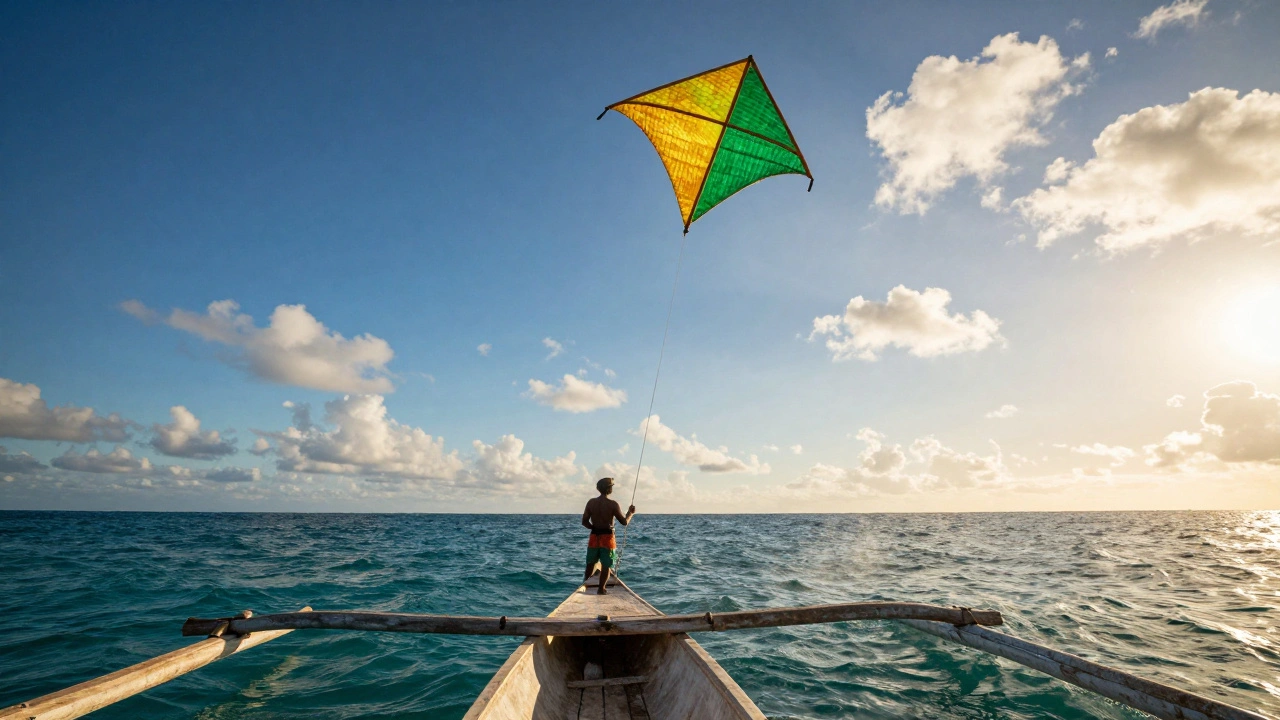
Imagine standing on the bow of a wooden outrigger canoe, the salt spray stinging your eyes, while a brightly colored fishing kite dances in the trade winds above you. You aren't looking at the water for fish; you are watching the sky. This is not a modern sport or a recreational hobby. It is an ancient survival technique that has sustained communities across the Pacific Ocean for centuries.
Kite fishing is often misunderstood as a leisure activity for tourists. In reality, it is a sophisticated method of deep-sea angling that allows fishermen to cast lines hundreds of feet offshore without drifting away from their boats. By using the wind power captured by large, durable kites, anglers can reach pelagic species like tuna, mahi-mahi, and wahoo that stay far beyond the reach of shore-based fishing. The practice connects the fisherman directly to the elements-wind, current, and wave-in a way that modern motorized boats simply cannot replicate.
The Mechanics of the Sky-Connected Line
To understand why this method persists, you have to look at the physics involved. A standard fishing rod limits your range to the length of the line you can hold or reel out manually. With a kite, the lift generated by the wing pulls the line outward and upward. The tension keeps the bait suspended at a specific depth, usually between 30 and 100 feet below the surface, which is exactly where many game fish feed.
The setup requires precision. The kite is attached to a long leader line, often made from braided nylon or traditional plant fibers in historical contexts. At the end of this leader hangs the hook with bait. As the boat moves-or stays stationary-the kite acts as a stable anchor point relative to the wind direction. If a fish strikes, the tug is transmitted through the line to the fisherman's hand, providing immediate feedback. Unlike trolling, where the boat's speed dictates the presentation, kite fishing relies on the natural drift and the angle of the wind.
This technique was born out of necessity. Before fiberglass hulls and gas engines, navigating open waters required vessels that were light enough to sail but sturdy enough to handle rough seas. The proa and the double-hulled catamaran designs found in places like Hawaii, Tahiti, and Samoa provided the perfect platform. These boats offered stability against the lateral pull of the kite without needing heavy ballast.
Crafting the Tools: From Bamboo to Breeze
The equipment used in traditional Pacific kite fishing is a testament to resourcefulness. Modern versions might use ripstop nylon and carbon fiber rods, but the heritage method relies on locally sourced materials. The frame of the kite is typically constructed from lightweight bamboo or flexible wood such as koa (in Hawaii) or fa'ato (in Samoa). These woods offer high tensile strength-to-weight ratios, essential for maintaining shape under high wind loads.
The covering of the kite varies by region. In some islands, woven pandanus leaves are treated with oil to make them waterproof and durable. In others, cotton cloth dyed with natural pigments is used. The colors are not just for aesthetics; bright reds, yellows, and oranges serve a functional purpose. They act as visual markers against the blue horizon, allowing the fisherman to track the position of the line even when visibility drops due to squalls or distance.
- Bamboo: Used for the main spars due to its flexibility and resistance to snapping.
- Pandanus Leaves: Woven tightly to create a semi-permeable surface that catches wind effectively.
- Cotton Cloth: Preferred in calmer climates for its smooth airflow properties.
- Natural Fibers: Coir or hibiscus bark used for tying joints and attaching the bridle.
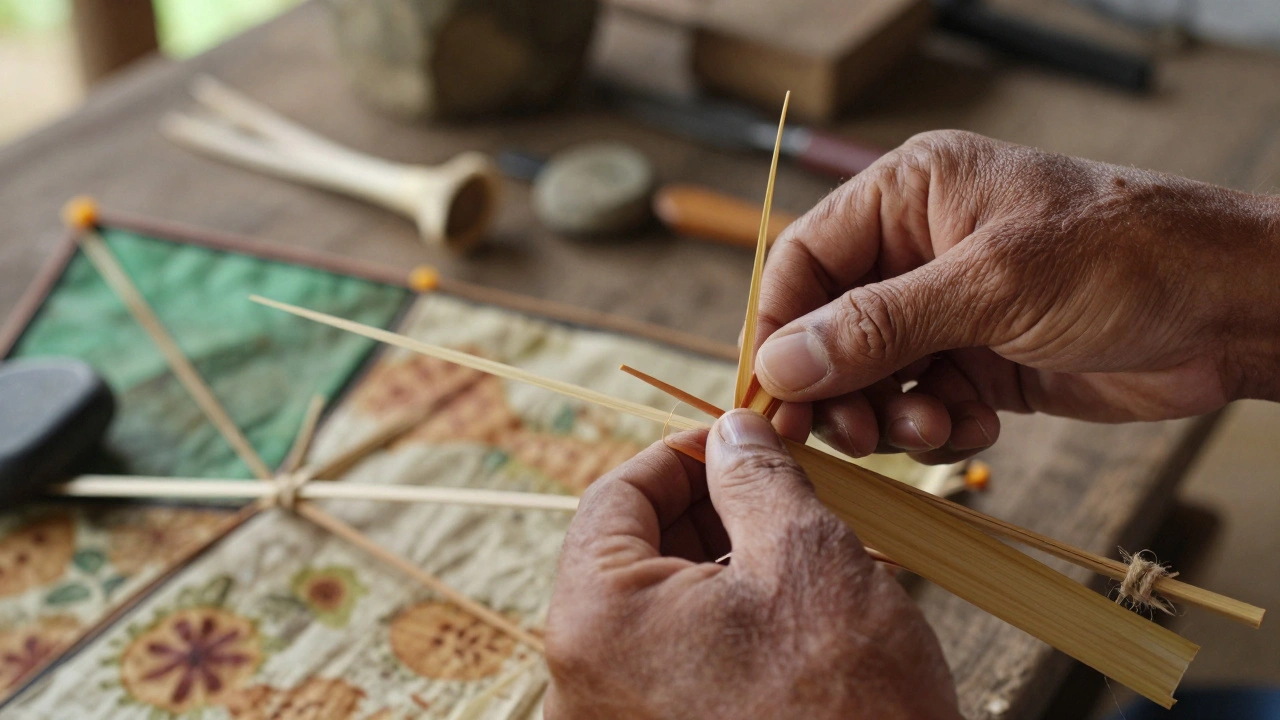
The construction process itself is a communal activity. Elders teach younger generations how to split bamboo into uniform strips, how to weave the lattice structure, and how to balance the center of pressure. This knowledge transfer ensures that the craft survives even as materials change. Today, you might see a hybrid approach where bamboo frames are covered with synthetic fabrics for longer life, but the underlying design principles remain unchanged.
Navigation and Reading the Ocean
You cannot kite fish if you do not understand the wind. Traditional Pacific navigators were masters of meteorology. They could predict changes in weather patterns by observing the behavior of birds, the color of the clouds, and the swell patterns hitting the reef. For kite fishing, this knowledge is critical. Flying a kite in shifting winds can lead to tangles, broken lines, or dangerous situations on small boats.
Fishermen learn to read the "trade wind" consistency. In the tropics, these winds blow steadily from the east-southeast during the day. A skilled fisherman positions his boat so that the kite flies directly downwind, maximizing the pull and keeping the line straight. If the wind shifts, the entire rig must be adjusted. This constant adjustment requires a deep connection to the environment. You are not fighting the ocean; you are cooperating with it.
The choice of location is also strategic. Kite fishing is most effective in clear, shallow waters near drop-offs or coral heads where predatory fish gather. The transparency of the water allows the bait to be seen clearly, while the kite's shadow can sometimes attract curious fish. However, flying too close to reefs risks snagging the line on submerged rocks. Therefore, the fisherman must balance the desire for proximity to fish with the safety margin required for maneuvering the boat.
Cultural Significance and Community Ties
In many Pacific cultures, fishing is more than food production; it is a spiritual and social obligation. The concept of Mālama Honua (care for the earth) permeates every aspect of fishing. Overfishing is avoided not just because of regulations, but because of cultural respect for the ocean's balance. Kite fishing, being a selective method, aligns well with these values. It targets specific species and avoids bycatch, unlike trawling nets that destroy habitats.
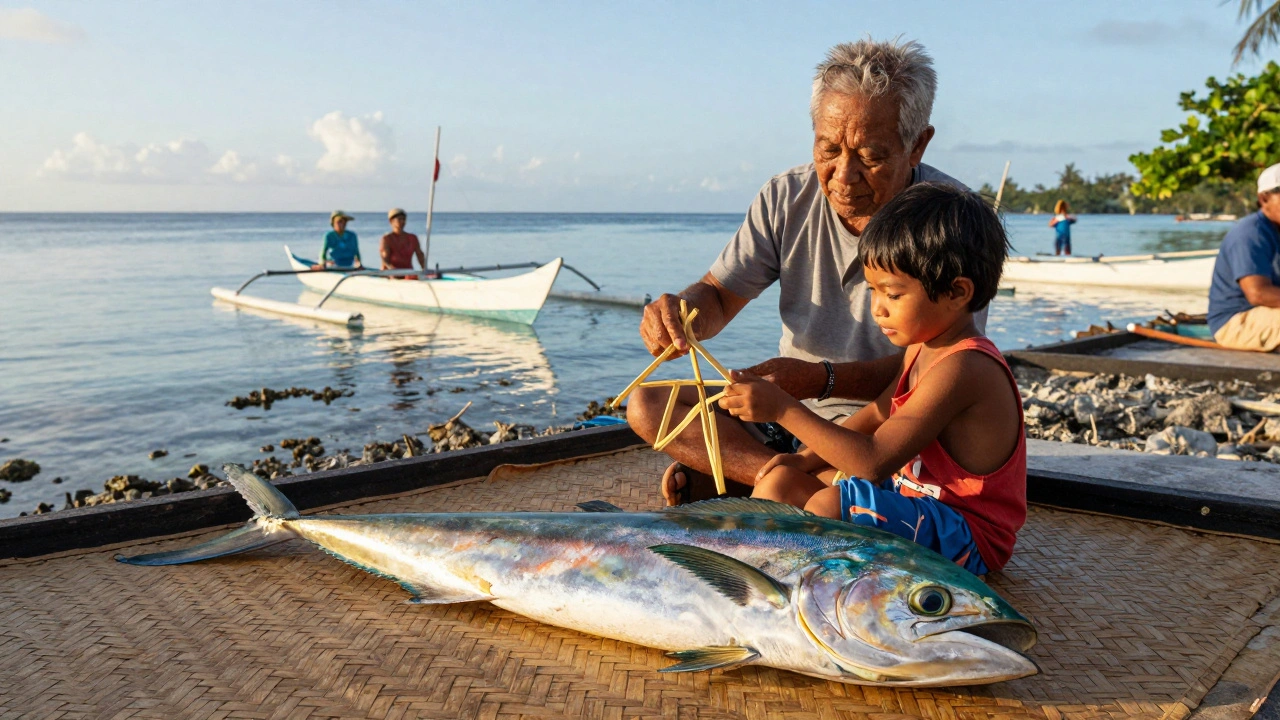
The preparation of the catch is equally important. Once a fish is landed, it is often shared among the community. The distribution follows strict protocols based on kinship and status. The head might go to the elder, the belly to the family of the fisherman, and the rest distributed to neighbors. This system ensures that no one goes hungry and reinforces social bonds. The kite, therefore, is not just a tool; it is a symbol of provision and generosity.
Festivals and competitions celebrate this heritage. In Hawaii, events like the Aloha Festivals often include demonstrations of traditional skills, including kite making and fishing. These events allow diaspora communities to reconnect with their roots and educate outsiders about the sophistication of indigenous technologies. They challenge the stereotype that traditional methods are primitive, showing instead that they are highly adapted solutions to environmental challenges.
| Component | Traditional Material | Modern Equivalent | Key Advantage |
|---|---|---|---|
| Kite Frame | Bamboo / Koa Wood | Carbon Fiber / Aluminum | Repairability vs. Weight |
| Kite Cover | Oiled Pandanus / Cotton | Ripstop Nylon / Polyester | Biodegradability vs. Durability |
| Line | Coir / Hibiscus Fiber | Braided Spectra / Dyneema | Floatation vs. Strength |
| Vessel | Wooden Outrigger Canoe | Fiberglass Catamaran | Cultural Authenticity vs. Stability |
Preserving the Practice in a Changing World
Despite its effectiveness, traditional kite fishing faces threats. Climate change alters wind patterns, making consistent conditions harder to find. Rising sea levels encroach on coastal launch sites. Furthermore, the influx of cheap, mass-produced gear tempts younger generations to abandon labor-intensive crafting methods. There is a risk that the intricate knowledge of material selection and aerodynamic balancing could be lost within a generation.
However, there is a resurgence of interest. Environmentalists appreciate the low-impact nature of the practice. Anglers value the unique thrill of catching fish without motors. Educational programs in schools across the Pacific Islands now include modules on traditional navigation and fishing. These initiatives ensure that the skills are passed down alongside the stories.
Learning to kite fish is not just about catching dinner. It is about understanding your place in the ecosystem. It teaches patience, observation, and respect for natural forces. Whether you are using a bamboo kite made by your grandfather or a modern composite version, the core experience remains the same: you are suspended between the sky and the sea, connected to the ancient rhythms of the Pacific.
What types of fish are best caught with kite fishing?
Kite fishing is particularly effective for pelagic species that swim in the upper layers of the ocean. Common catches include yellowfin tuna, bigeye tuna, mahi-mahi (dolphinfish), wahoo, and barracuda. These fish are attracted to the movement of the bait and the shadow of the kite, making them aggressive biters.
Can anyone learn to fly a fishing kite?
Yes, but it requires practice. Beginners should start in calm, consistent winds and with smaller kites. Mastering the balance between the pull of the kite and the drag of the line takes time. It is recommended to learn from experienced local fishermen who can teach you how to read wind shifts and manage line tension safely.
Is traditional kite fishing environmentally friendly?
Yes, it is considered one of the most sustainable fishing methods. It produces minimal bycatch, does not damage coral reefs or seabeds, and uses renewable materials in its traditional form. The lack of motor noise also reduces stress on marine life, creating a quieter underwater environment.
What is the difference between a proa and an outrigger canoe?
An outrigger canoe has a single hull with one or two stabilizing floats (ama) attached by booms. A proa is a type of multihull vessel where the ama is larger than the main hull and can be moved from side to side depending on the wind direction. Proas are faster and more efficient for sailing but require more skill to handle.
How do I maintain a traditional bamboo fishing kite?
After each use, rinse the kite with fresh water to remove salt, which can weaken bamboo and rot fabric. Store it in a dry, shaded area to prevent UV damage. Inspect the joints regularly for cracks or loose bindings. Re-oil the bamboo spars annually with coconut or linseed oil to maintain flexibility and prevent drying out.