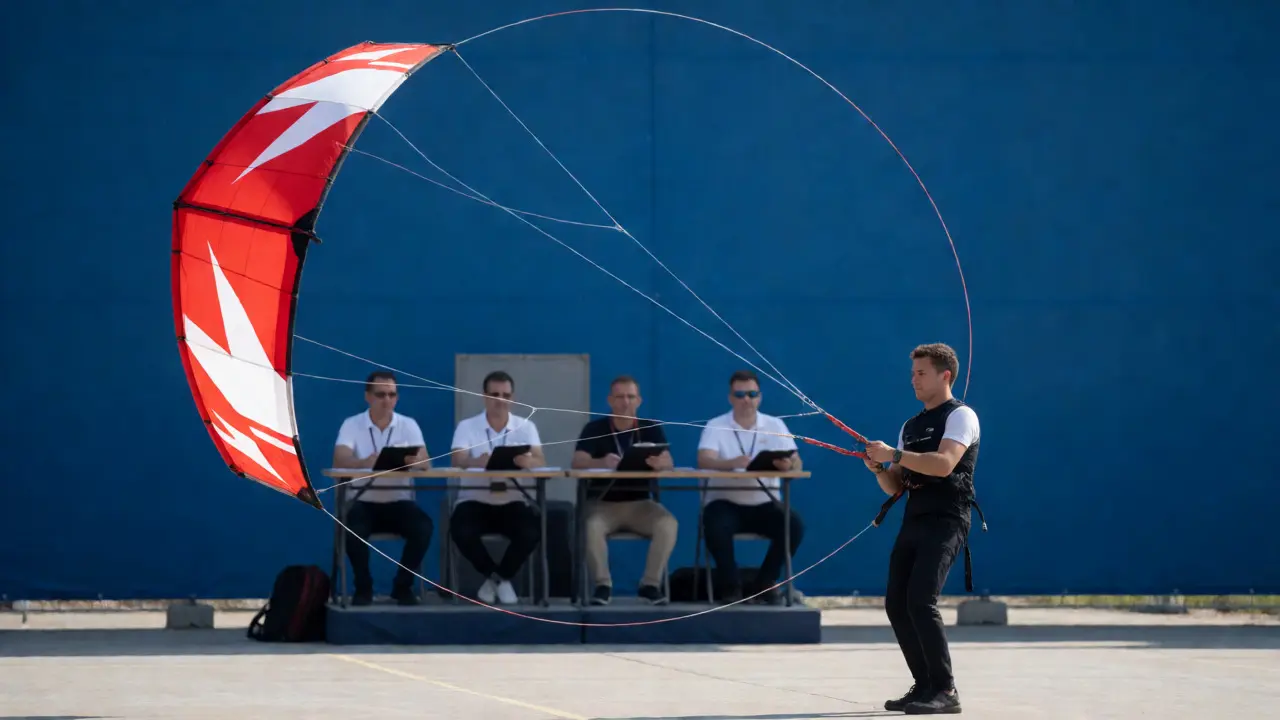
Ever watched a sport kite flyer execute a perfect figure-eight and wondered why one competitor gets a 9.5 while another with the same move gets an 8.0? It feels arbitrary from the ground, but up in the judges' booth, it’s pure math mixed with artistry. If you’re stepping onto the line at your first major competition, or if you’ve been competing for years and still feel like the scores are a mystery, you need to decode the rulebook.
The difference between winning and losing often comes down to understanding exactly what the judges are looking for. They aren't just watching for cool tricks; they are evaluating specific attributes of flight path, body control, and risk management. Let’s break down the actual mechanics of how freestyle and ballet routines are scored, so you can stop guessing and start training for points.
Decoding the Scorecard: Technical vs. Artistic Merit
Most international competitions, including those governed by the Sport Kites Association (SKA) and the World Air Sports Federation (FAI), split the score into two distinct buckets: Technical Merit and Artistic Impression. You might think nailing every trick guarantees a win, but that’s a trap. A routine full of hard moves executed sloppily will always lose to a simpler routine flown with surgical precision.
Technical merit is objective. Judges look for clean lines, proper posture, and correct execution of named maneuvers. Did you fly the loop perfectly round? Did you maintain the required altitude? Was your stance stable? These are binary checks-either you did it right, or you didn’t. Artistic impression is subjective but not random. It covers choreography, music synchronization, and crowd appeal. The key insight here is balance. A routine that is 100% technical fireworks but has no flow looks like a checklist, not a performance. Conversely, a beautiful dance with basic moves lacks the difficulty multiplier needed for top-tier placement.
| Category | Weight | What Judges Look For |
|---|---|---|
| Technical Execution | 40-50% | Accuracy of shapes, stability, landing precision, safety protocols. |
| Difficulty (Degree of Difficulty) | 20-30% | Complexity of maneuvers, speed variations, unusual angles. |
| Artistic Presentation | 20-30% | Music sync, choreography flow, costume/appearance, emotional impact. |
| Faults/Deductions | Negative Points | Crashes, touching the ground, going out of bounds, time violations. |
Ballet Precision: The Geometry of Flight
Sport kite ballet is essentially gymnastics in the sky. Unlike freestyle, where you have more creative freedom, ballet demands strict adherence to geometric patterns. Judges are trained to spot deviations as small as five degrees. When you fly a box, it needs to be a square, not a rectangle. When you fly a circle, it needs to be centered relative to the wind window, not drifting off-center due to poor line tension management.
A common mistake flyers make is focusing on their hands instead of their feet. In ballet, your footwork determines your body position, which dictates the kite's path. If your stance is wide and unstable, your arms will shake, and the kite will wobble. Judges penalize this heavily under "stability." To maximize your score, practice flying with a narrow stance and keep your elbows tucked close to your torso. This reduces extraneous movement and makes the kite appear to glide effortlessly.
Another critical aspect is the "clean exit" and "clean entry." Transitions between maneuvers matter as much as the maneuvers themselves. If you finish a loop and immediately jerk into a dive, you lose points for fluidity. Smooth transitions demonstrate mastery over the control lines. Remember, the judge sees the whole picture, not just isolated tricks. A seamless connection between two medium-difficulty moves often scores higher than two high-difficulty moves separated by a clumsy pause.

Freestyle Freedom: Risk, Reward, and Creativity
Freestyle is where personality shines. Here, the judging criteria shift slightly toward creativity and risk assessment. While ballet asks "Did you fly the shape correctly?", freestyle asks "Was this interesting?" and "How hard was it?"
Degree of Difficulty (DD) is calculated differently here. It’s not just about listing hard tricks; it’s about combining them in unexpected ways. A standard loop is easy. A loop followed by a rapid direction change while maintaining low altitude is harder. Judges reward innovation. If you incorporate a maneuver rarely seen in competition, such as a complex inverted spin or a high-speed slalom through imaginary gates, you gain a DD bonus. However, this comes with risk. If you crash during a high-DD move, the deduction usually outweighs the potential bonus. The sweet spot is attempting moves you can land 9 times out of 10.
Music synchronization is paramount in freestyle. It’s not enough to just have background noise. Your peak moments-the fastest spins, the biggest dives-should hit the beat drops or crescendos. Judges often wear headphones or listen via speakers, and they subconsciously match visual intensity to audio intensity. If your kite is flying lazily during the most energetic part of the song, you’ll lose artistic points. Conversely, if you save your best trick for the quiet intro, it feels disjointed. Edit your music track to ensure there are clear cues for your hardest moves.
The Deduction Trap: Where Flyers Lose Points
You can have a flawless routine and still lose because of hidden deductions. These are non-negotiable errors that automatically subtract points regardless of how pretty your flight looked. Understanding these pitfalls is half the battle.
- Ground Touches: Any contact between the pilot’s body (other than feet) and the ground results in a deduction. This includes kneeling, sitting, or even brushing grass with your hand during a low pass.
- Out of Bounds: Flying outside the designated wind window or arena boundary breaks immersion and disrupts the visual frame. Judges deduct for each second spent out of bounds.
- Line Tangles: If your lines cross and require you to stop flying to untangle them, it’s a major fault. It breaks the rhythm and signals poor line management skills.
- Time Violations: Most routines have strict time limits (e.g., 3 minutes plus or minus 15 seconds). Starting too early or finishing too late incurs penalties. Always time your practice runs rigorously.
- Equipment Failure: If a line snaps or the kite deforms mid-flight, you may get a re-fly opportunity, but usually only once per competition day. Relying on luck is risky; inspect your gear before every run.
One subtle deduction involves "excessive adjustment." If you constantly tweak your grip or stance visibly, judges perceive it as lack of confidence. Keep adjustments minimal and smooth. Practice making micro-corrections with your fingers rather than large arm movements.

Mastering the Wind Window: Environmental Awareness
Judges don’t operate in a vacuum. They know the weather conditions. A flyer who struggles in gusty winds but recovers gracefully shows skill. A flyer who ignores the wind and crashes repeatedly does not. Part of the judging criteria implicitly evaluates your ability to read the air.
In Portland, for example, thermal activity can create sudden updrafts and downdrafts. Experienced competitors adjust their routine dynamically. If a gust hits, they might expand a loop to maintain power or slow down a dive to prevent overshooting. Novices try to force the planned trajectory and end up fighting the kite. Judges reward adaptability. If you encounter turbulence, don’t panic. Use it. Turn a shaky moment into a dramatic pause or a powerful pull-up. Showing control in adverse conditions demonstrates true expertise.
Also, consider the sun angle. Judges are human. If the sun is directly behind your kite, it creates a silhouette effect that can obscure details. Position yourself so the sun illuminates the kite’s face, not its back. This ensures your colors pop and your maneuvers are clearly visible. Small logistical choices like this can subtly influence the overall impression score.
Preparing for the Judge’s Eye: Training Tips
How do you train specifically for scoring? First, record your practice sessions. Watch them back without sound. Does the routine look smooth? Are there jerky transitions? Then watch with sound. Do the moves match the music? Share videos with experienced flyers who have judged competitions. Ask them to point out flaws you’ve become blind to.
Second, simulate pressure. Practice in front of friends or family. Get used to being watched. Nervousness causes muscle tension, which ruins fine motor control. If you can fly smoothly while someone critiques you loudly, you’ll handle the silent scrutiny of judges well.
Finally, focus on consistency over complexity. A routine with ten solid medium-difficulty moves flown perfectly will often beat a routine with three impossible moves and seven sloppy ones. Build your base first. Once your basics are unshakeable, layer in the difficult elements. Remember, judges hate uncertainty. Give them a predictable, high-quality performance, and the scores will follow.
Do I lose points if my kite touches the ground?
Yes, typically. In most sport kite competitions, any part of the kite or pilot other than the feet touching the ground results in a deduction. If the kite lands completely, it is often considered a crash, leading to significant point loss or termination of the routine depending on the specific rules of the event.
How important is music selection in freestyle?
Extremely important. Music sets the tempo and mood for the entire routine. Judges evaluate synchronization between the kite's movements and the audio cues. Poorly edited music or mismatched pacing can significantly lower your artistic impression score, even if your technical flying is excellent.
Can I use any type of kite for ballet competitions?
No, you must use a dual-line stunt kite designed for precision flying. Single-line kites or parafoil kites generally do not meet the requirements for standard sport kite ballet or freestyle divisions unless specified by a niche category. Ensure your kite is approved by the governing body of the competition.
What happens if I go over the time limit?
Most competitions allow a grace period, usually around 15 seconds. If you exceed the maximum time limit, you receive a time penalty deducted from your total score. In severe cases, the judges may stop your routine entirely. Always aim to finish comfortably within the allowed window.
Does audience reaction affect the score?
Indirectly, yes. While judges score based on the rubric, audience engagement contributes to the overall atmosphere and can influence the subjective "presentation" score. A routine that captivates the crowd often leaves a stronger lasting impression on judges than one that flies silently and unnoticed.