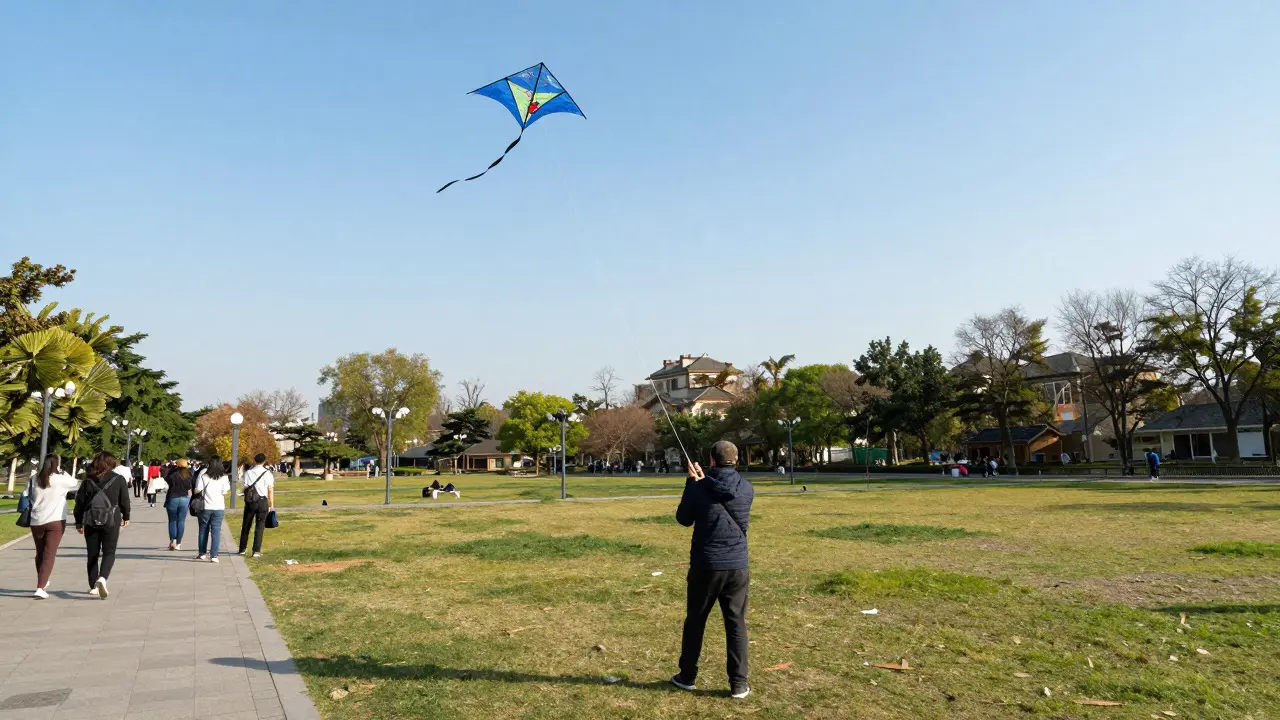
You’re standing at the edge of a park, watching your diamond kite climb into the blue. It feels liberating. But then you realize the sidewalk is just ten feet away, and a cyclist is rounding the corner fast. How close is too close? Most accidents don’t happen because the kite crashes; they happen because the line snaps, or the pilot gets distracted by the wind shift and walks backward into a street. Getting the spacing right isn’t about being paranoid-it’s about respecting the physics of a taut string under load.
Key Takeaways
- Kite safety requires a minimum buffer of 50 feet from pedestrians and 100 feet from vehicle traffic.
- Always fly downwind of people to prevent the kite from diving into them during gusts.
- Check local ordinances; many cities ban kites within 300 feet of airports and power lines.
- Use a reel with a brake for large kites to control sudden descents.
- Never fly near high-voltage power lines, as wet lines conduct electricity easily.
Why Distance Matters More Than You Think
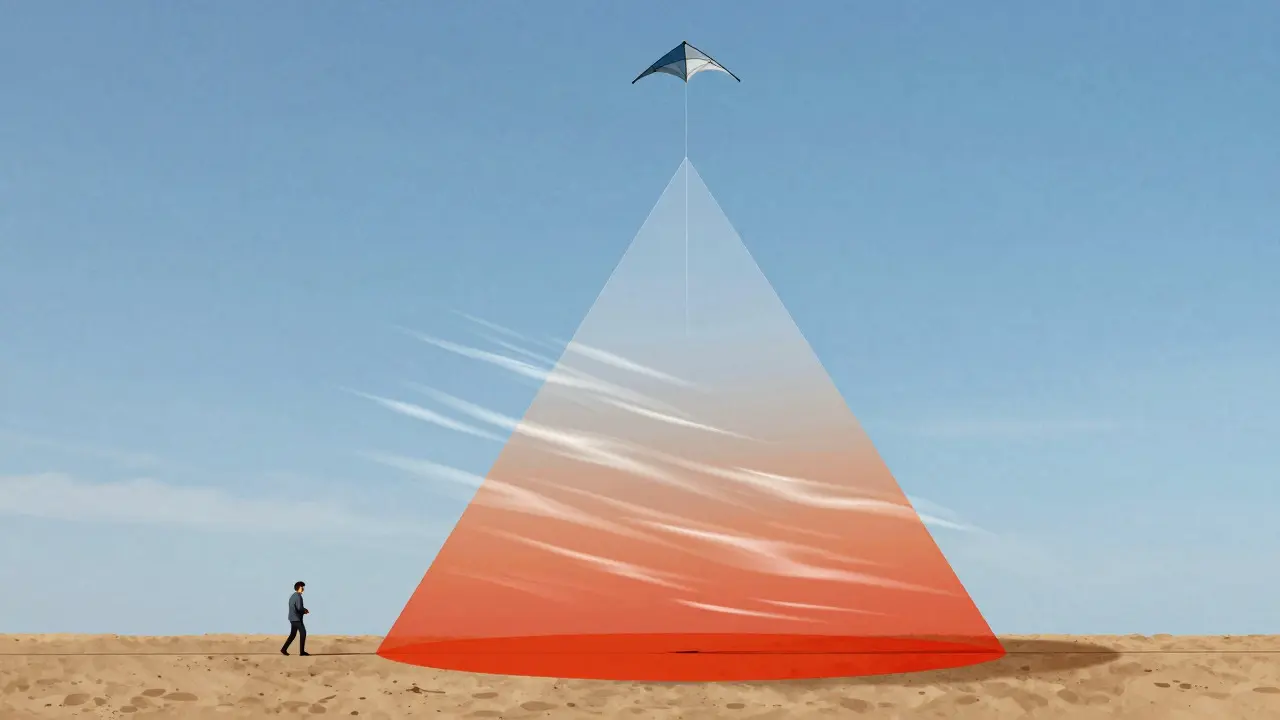
A standard recreational kite can weigh anywhere from 2 to 10 pounds, but its aerodynamic force is what really matters. When the wind hits 15 mph, a medium-sized delta kite generates enough lift to pull a 150-pound adult off their feet if the line breaks or slips. The danger zone isn’t just where the kite is; it’s the entire cone of potential descent. If you are standing still, the kite might stay put. But if you move, or if the wind shifts even slightly, that cone expands rapidly.
Consider the reaction time factor. If a child runs toward you, they have no concept of "line tension." They see a colorful shape and run. By the time you spot them, you’ve already lost 10 seconds of control. That’s why static distance is your first line of defense. You need enough space to react, release the line, or steer the kite away before contact occurs.
The Golden Rule: Downwind Placement
Here is a rule that saves more fingers than any amount of padding: always stand upwind of the people you want to protect. If the wind is blowing from the north, you should be on the north side of the crowd, letting the kite fly south over their heads. Why? Because kites naturally lose altitude when they encounter lulls in the wind or when you ease off the line. If you are downwind (south) of the crowd, and the wind dies, the kite drops straight down onto the nearest person. If you are upwind, the kite drifts away from them.
This principle applies equally to traffic. Never fly between a group of people and a road. Put yourself between the two hazards. This creates a natural barrier. If the kite dives, it comes toward you, not toward the cars. You can catch it or let it land in the grass. If it flies away, it goes over the heads of the spectators, not into the path of a moving sedan.
Navigating Urban Spaces and Traffic
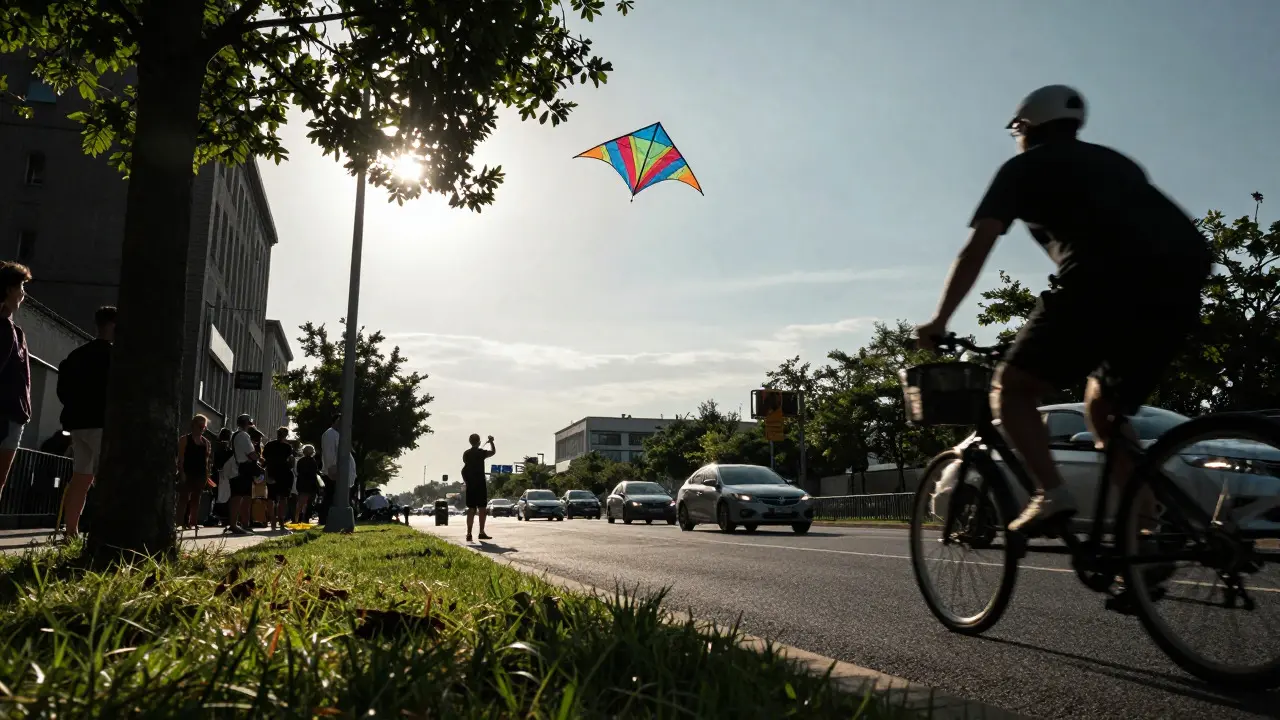
Flying in a city like Portland offers great open spaces, but also complex traffic patterns. Sidewalks are pedestrian zones, not flight paths. Even if the street looks empty, a delivery truck or a school bus could appear without warning. The general consensus among experienced flyers is to maintain a 100-foot buffer from any active roadway. This accounts for the width of the road, the shoulder, and the potential for a car to swerve.
If you must fly near a road-perhaps in a coastal area where space is limited-use a whistle. It sounds simple, but a sharp blast cuts through wind noise better than shouting "Watch out!" It alerts drivers and pedestrians instantly. Also, avoid flying directly above intersections. The cross-traffic makes it impossible to predict which direction a hazard will come from. Stick to long, straight stretches of road where visibility is clear in both directions.
| Hazard Type | Minimum Distance | Reasoning |
|---|---|---|
| Pedestrians (Stationary) | 50 feet | Allows time to react to sudden line slack or gusts. |
| Pedestrians (Moving/Children) | 75 feet | Accounts for unpredictable running paths and slower reaction times. |
| Vehicle Traffic (Slow) | 100 feet | Covers road width plus emergency swerve margin. |
| Vehicle Traffic (High Speed) | 150+ feet | Required for highways or roads with speeds over 35 mph. |
| Power Lines | 300+ feet | Wet kite lines conduct electricity; keep far away. |
The Hidden Danger: Power Lines and Infrastructure
We often focus on people, but infrastructure kills kites-and sometimes pilots. High-voltage power lines are the biggest enemy. Unlike low-voltage household wires, these carry thousands of volts. A dry nylon line is an insulator, but add a bit of moisture from rain or humidity, and it becomes a conductor. If your kite touches a line, the current can travel down the string to your hand. The shock can be fatal or cause severe burns.
Always check the sky before launching. In urban areas, power lines are often hidden behind trees or buildings. Use a compass app or simply observe the shadow of nearby poles. If you can’t clearly see the path of the lines, assume they are there. A safe rule of thumb is to stay at least 300 feet away from any visible transmission tower or utility pole cluster. For local distribution lines (the ones on wooden poles), 100 feet is usually sufficient, provided the line is dry and the wind isn’t pushing the kite unpredictably.
Choosing the Right Gear for Control
Your equipment dictates how much control you actually have. If you are using a simple stick handle, you are relying on friction and your grip strength. This works for small, lightweight kites in light winds. But for anything larger, or in gusty conditions, a reel is non-negotiable. A good kite reel allows you to pay out line quickly and, more importantly, to brake the line smoothly. If a gust catches your kite and it starts to dive, you can use the brake to slow the descent rather than fighting against the full force of the wind with bare hands.
Look for reels with a maximum capacity of at least 300 meters for serious flying. More line means more distance, which translates to more safety buffer. However, remember that more line also means more weight and drag. For casual park flying, a 100-meter spool is often enough. Just ensure the line is strong. Braided Dacron or Spectra line is preferred over monofilament because it doesn’t stretch as much, giving you better feedback on tension changes.
Local Laws and Common Sense
Safety isn’t just physical; it’s legal. Many municipalities have specific rules about where kites can be flown. In some parts of the US, it is illegal to fly a kite within 300 feet of an airport runway or helipad. Check with your local parks department or aviation authority. Violations can result in fines, and worse, a collision with a small aircraft. Even if the law is vague, common sense applies. Avoid flying in crowded plazas during peak hours. Choose early morning or late afternoon when foot traffic is lower. These times also tend to have steadier winds, which makes controlling the kite easier.
Finally, communicate. If you are flying in a shared space, let people know. A simple "Kite flying here, please give me some room" goes a long way. Most accidents happen because people assume you are stationary. Let them know you are active, and they will adjust their path accordingly.
Emergency Procedures: What to Do When Things Go Wrong
Even with perfect planning, things go wrong. Maybe the wind suddenly dies, or a bird attacks the kite. Here is how to handle common emergencies:
- The Line Snaps: Don’t chase the kite immediately. First, secure your end of the line so it doesn’t whip around. Then, assess the area. If the kite lands on someone, call for help only if they are injured. Often, people are just startled. Walk toward the kite slowly, showing your hands are empty.
- The Kite Gets Stuck: If it catches in a tree or fence, do not climb up to get it. Use a long pole or wait for the wind to change. Climbing increases the risk of falling, especially if the branch is thin.
- Lightning Storm: If you hear thunder, pack up immediately. Lightning seeks the highest object, and your kite is a perfect target. The 30-second rule applies: if the flash-to-bang interval is less than 30 seconds, you are in danger.