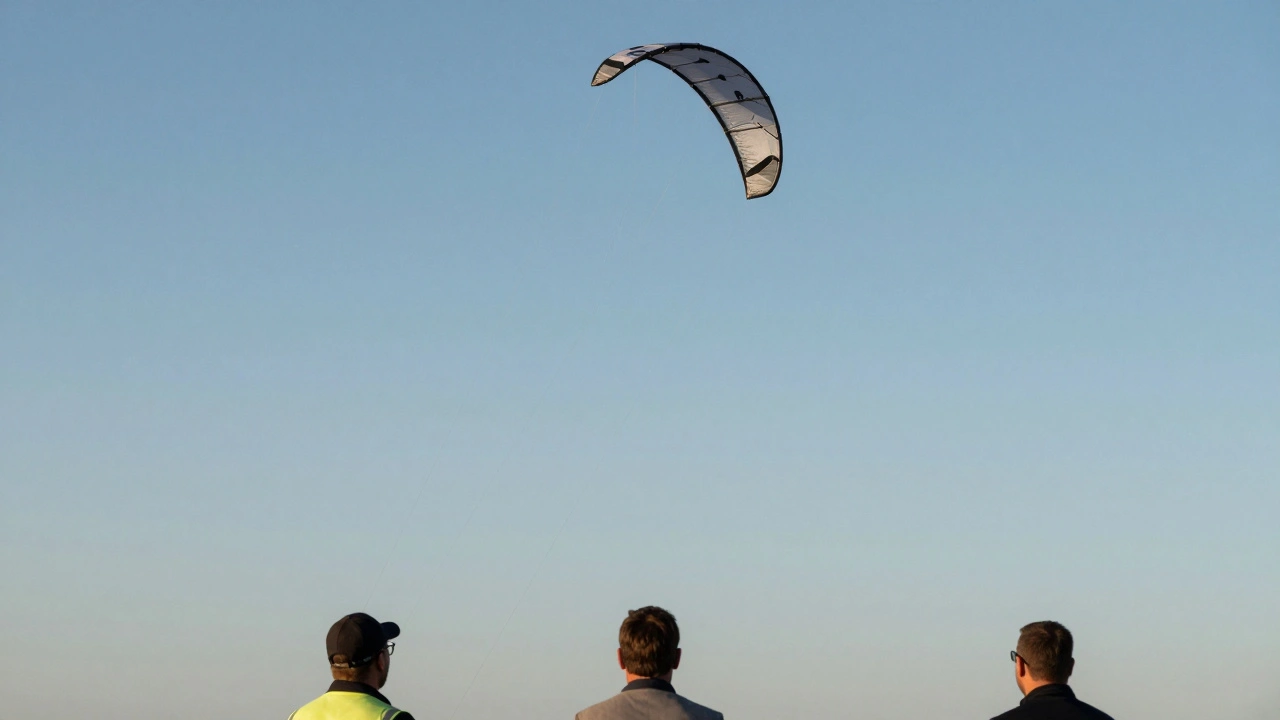
Ever watched a kite dance across the sky like it’s on a string of magic and wondered how judges even decide who wins? It’s not just about how high it flies or how colorful it looks. In precision kite flying, every turn, every hover, every ripple in the fabric is measured. This isn’t a free-form art show-it’s a sport with strict rules, exact points, and judges who notice if a kite’s wing dips half a degree too low.
What Is Precision Kite Flying?
Precision kite flying is a competitive discipline where pilots fly kites along pre-set patterns called figures. These aren’t random swirls or tricks. Each figure is a geometric shape-like a square, a circle, or a figure-eight-drawn in the sky with perfect symmetry and timing. Think of it as aerial ballet, but with a rigid scorecard.
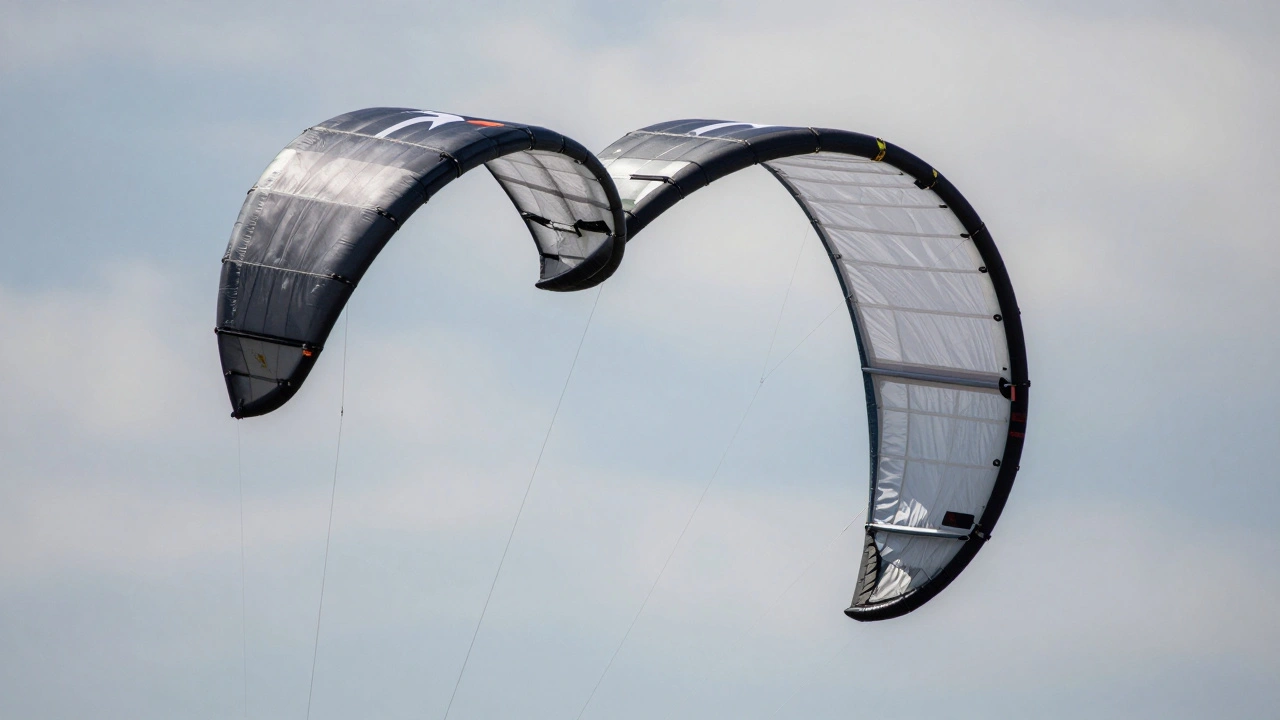
The kites used are usually dual-line or quad-line, designed for maximum control. They’re lightweight, with carbon fiber frames and ripstop nylon or polyester sails. Unlike sport kites that do loops and dives for crowd applause, precision kites fly smooth, repeatable paths. The goal? To make every flight look identical to the one before it. No improvisation. No flair. Just perfection.
The Scoring System: How Points Are Awarded
Each competition has a list of 10 to 15 figures. Pilots fly them one after another, and each figure is scored from 0 to 10. A score of 10 means flawless execution. A 5 means noticeable errors. A 0? That’s when the kite crashes, or the pilot completely misses the pattern.
Here’s how it breaks down:
- Shape Accuracy (40%): Did the kite trace the exact shape? A perfect circle isn’t just round-it has to be centered, symmetrical, and the right size. A square must have equal sides and 90-degree corners.
- Positioning (30%): Where the figure is flown matters. Every pattern has a designated zone in the sky, usually a 60-meter wide by 40-meter tall box. Flying too high, too low, or drifting left or right loses points.
- Timing and Smoothness (20%): Each figure has a set duration. Too fast? You lose control. Too slow? The kite stalls. The transitions between movements must be fluid, with no jerks or wobbles.
- Line Tension and Control (10%): The lines should stay taut and parallel. If one line sags or crosses, it shows poor control. Judges look for clean, consistent tension throughout.
There’s no partial credit. If a kite wobbles during a circle, it’s not a 7.5-it’s a 6 or a 5, depending on how bad the wobble was. Judges don’t average. They pick one number based on the overall impression.
How Judging Works: The Panel and Their Role
A typical competition has five judges, each sitting in a different spot around the flying field. Their job isn’t to cheer or cheerlead-it’s to watch for one thing: deviation from the ideal.
Each judge scores independently. After all pilots fly, the highest and lowest scores for each figure are dropped. The middle three scores are averaged. That’s the final score for that figure. This system removes outliers-like the judge who’s a fan of the pilot or the one who got distracted by a bird.
Judges don’t talk to each other during scoring. They use standardized forms with checklists. Before each event, they undergo certification. In the U.S., that’s handled by the American Kitefliers Association (AKA). In Europe, it’s the FAI (Fédération Aéronautique Internationale). They train for months on how to spot a 2-degree angle error in a diamond figure.
There’s no room for bias. If a pilot has won three years in a row, judges are extra careful. They’re trained to question themselves: "Is this really perfect, or am I just impressed by reputation?"
Common Mistakes That Cost Points
Even experienced pilots lose points on things most spectators wouldn’t notice:
- Asymmetrical figures: One side of a triangle is 5% longer than the other? That’s a 2-point drop.
- Unbalanced turns: A figure-eight that’s lopsided, with one loop bigger than the other? That’s a 3-point penalty.
- Line twist: If the lines twist around each other during a maneuver, it’s a sign of poor control. Even if the kite still flies the pattern, you lose points.
- Wind drift: Flying in a steady breeze is one thing. But if the kite drifts 10 meters to the right during a square, you’re not just off-center-you’re out of bounds.
- Stopping too long: Some figures require a pause. But if the kite hangs in the air for 0.3 seconds too long? That’s not a pause-it’s a stall. Penalty.
One pilot in the 2025 National Precision Kite Championship lost 8 points total on a single figure because the kite’s tail didn’t hang straight. It fluttered 5 degrees left. The judges didn’t care about aesthetics-they cared about control. And control is what precision is built on.
Training for Precision: How Pilots Practice
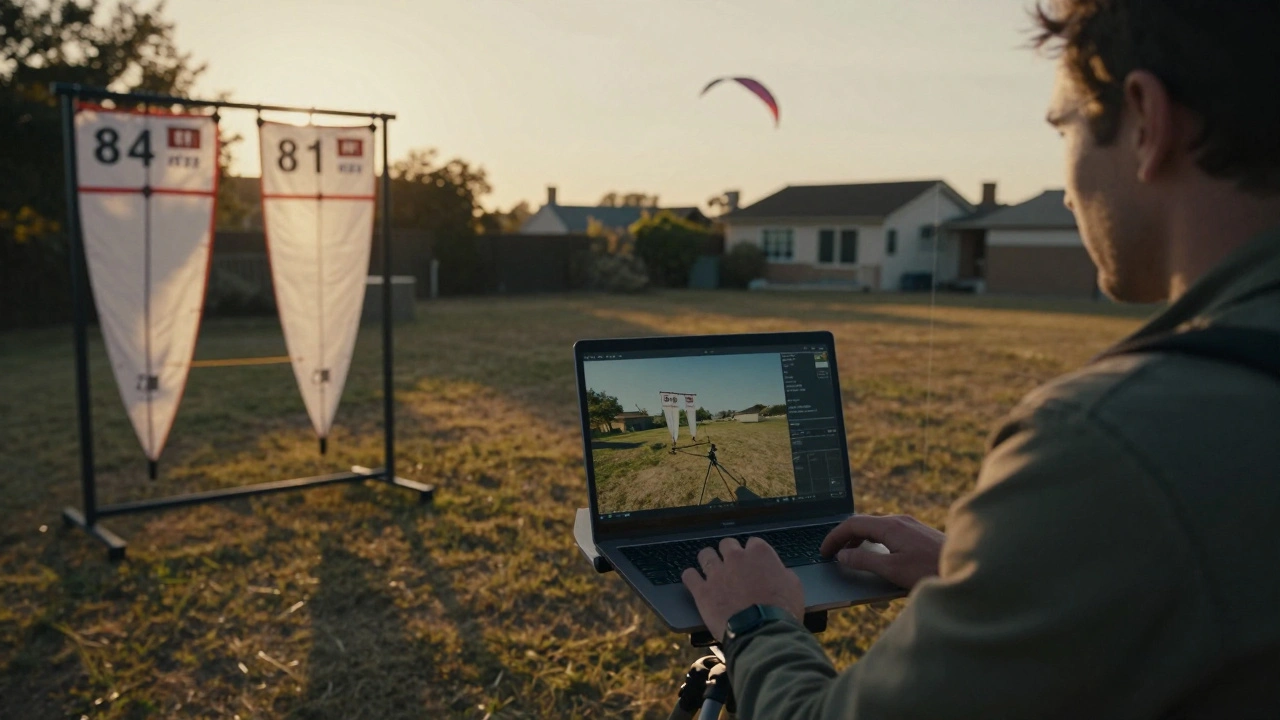
You don’t just show up and win. Top pilots spend hours in their backyards, flying the same figure over and over. Some use video analysis, recording flights and slowing them down frame by frame. Others use laser-guided training rigs that project the exact figure onto the ground, so they can practice footwork and line tension before ever lifting a kite.
Many use software like KiteTrak or AeroScore, which simulate competition patterns and give instant feedback. These tools can tell you if your circle’s radius varied by 2% or if your turn timing was off by 0.1 seconds. That kind of data used to be impossible to get. Now, it’s standard.
Practice isn’t about flying higher or faster. It’s about flying the same thing 50 times-and making each one identical. That’s the discipline.
Competition Levels and Categories
Competitions are split by skill level and kite type:
- Beginner: 5 simple figures, like straight lines, circles, and basic squares. No advanced transitions.
- Intermediate: 10 figures, including figure-eights, triangles, and spirals. More emphasis on symmetry.
- Advanced: 15 complex figures, some with multiple loops, reversals, and timed pauses. These are the ones you see at World Championships.
- Quad-line: For kites with four lines, allowing full 3D control. These pilots can hover, spin, and flip mid-air-still within strict figure boundaries.
There are also team events, where two pilots fly synchronized patterns. It’s like a duet, but with kites. One mistake by either pilot ruins the score for both.
What Makes a Champion?
Winning isn’t about having the fanciest kite. It’s about consistency under pressure. The best pilots have one thing in common: they treat every flight like a test. They don’t fly to impress. They fly to prove they can repeat perfection.
At the 2025 World Kite Precision Championship in Germany, the winner scored 9.7 out of 10 on every single figure. That’s 150 points out of 150 possible. No one else broke 9.5 on more than three figures. The difference wasn’t skill-it was focus. The winner had practiced the same 15 figures for 18 months, recording every flight, adjusting every line tension, and correcting every micro-error.
It’s not magic. It’s repetition. It’s discipline. It’s the quiet obsession of flying the same shape, over and over, until the sky becomes your canvas-and your ruler.
Can you win a kite competition with a cheap kite?
Yes, but it’s rare. The kite itself doesn’t score points-your control does. However, a low-quality kite may not hold its shape, respond precisely, or maintain line tension. Most top competitors use custom-built kites with carbon frames and precision-sewn sails. A cheap kite might work for beginners, but at advanced levels, even a 1% deviation in weight or fabric tension can cost you 2-3 points per figure.
Do judges ever disagree on scores?
They can, but the scoring system is designed to handle it. Each judge scores independently, and the highest and lowest scores for each figure are thrown out. Only the middle three are averaged. This means even if one judge is too harsh and another too lenient, their impact is minimized. In rare cases, if the middle three scores differ by more than 2 points, the chief judge may review the flight footage to ensure consistency.
Is there a difference between indoor and outdoor precision kite flying?
Yes. Outdoor flying depends on wind conditions, which change constantly. Pilots must adapt their line tension and timing on the fly. Indoor flying uses electric fans to simulate steady wind, so the focus is purely on mechanical precision. Indoor competitions are often used for training because they remove wind variables. But official world events are always held outdoors.
How do you know if a kite figure is centered in the sky?
Judges use a mental grid called the "flying box"-a 60m wide by 40m tall zone directly in front of them. The center of this box is the ideal position. Pilots are trained to fly each figure so its center aligns with this zone. If a circle drifts 5 meters left, it’s still a circle-but it’s no longer centered. That’s a 2-point deduction. Some competitions use ground markers or laser pointers to help judges verify positioning.
Can you practice precision kite flying alone?
Absolutely. In fact, most top pilots train alone. Group flying is for team events. Precision is about personal mastery. You need to fly the same figure 20 times in a row and compare each one. Many use video recordings, timers, and even smartphone apps that track kite position. You don’t need a crowd-you need a mirror, a stopwatch, and the patience to fix tiny errors.