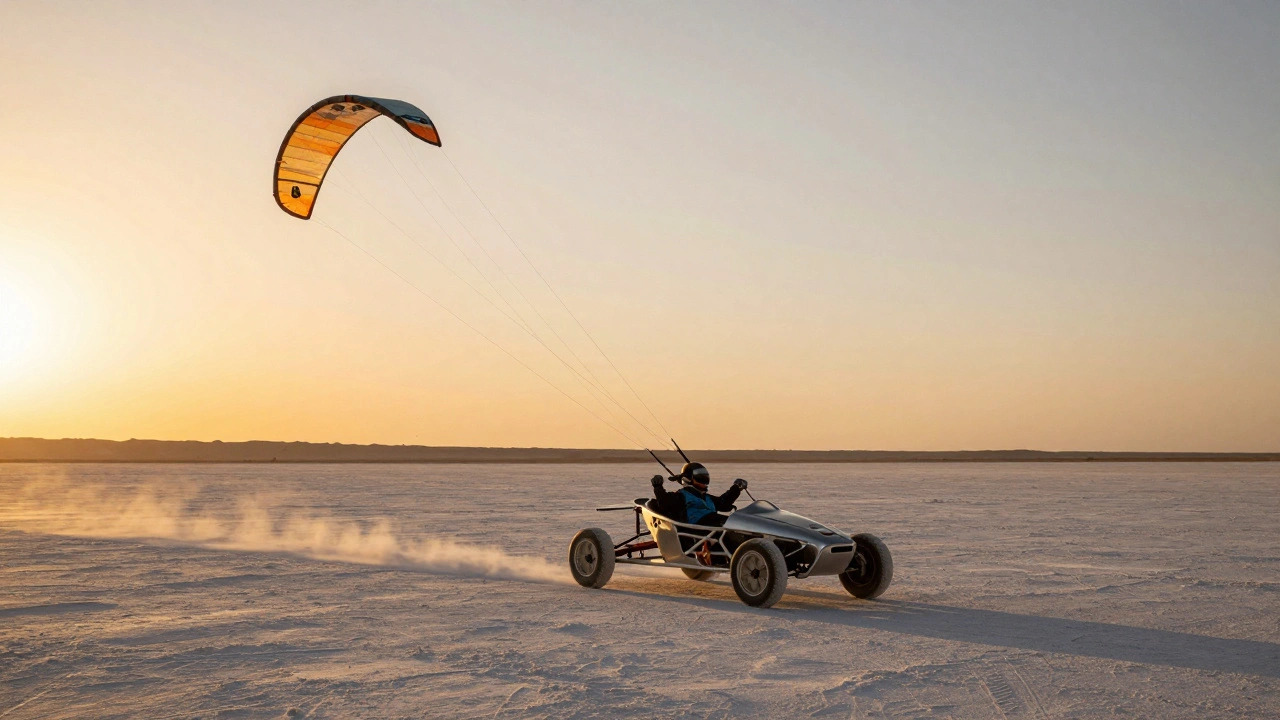
Most people think of kiteboarding as something you do on water-wind pulling you across waves, board underfoot, lines taut in your hands. But there’s a whole other side to it that doesn’t need a lake, ocean, or even wet sand. Land kiteboarding is real, wild, and growing fast. You don’t need water to feel the rush of a kite pulling you forward at 30 miles an hour. All you need is open space, a kite, and a wheeled board. Three main styles dominate this dry-land scene: buggying, landboarding, and mountain boarding. Each has its own gear, feel, and crowd. And each lets you ride the wind without ever getting your feet wet.
What Is Land Kiteboarding?
Land kiteboarding is exactly what it sounds like: using a power kite to pull you across solid ground. It’s not a hybrid sport. It’s kiteboarding stripped down to its core: wind energy + human motion. The kite is the engine. Your board or buggy is the chassis. And the ground? It’s your runway. Unlike water kiteboarding, where you fight currents and waves, land riding gives you smooth, consistent traction. No chop. No salt. No cold. Just wind, speed, and control.
The sport exploded in the early 2000s after kitesurfing became popular. People started wondering: if you can ride a kite on water, why not on dirt? Early adopters used modified skateboards, then wheeled carts, then purpose-built rigs. Today, there are dedicated manufacturers, competitions, and even land kiteboarding parks in places like Oregon’s Columbia Gorge and Nevada’s Black Rock Desert.
Buggying: The Fastest Way to Ride the Wind
If you want speed, buggying is your game. A kite buggy is a three-wheeled, low-slung cart with a seat, steering bar, and footrests. It looks like a go-kart built by a mad scientist. Most are made from lightweight aluminum or carbon fiber. They weigh under 30 pounds and can hit 50+ mph with a 12m kite in 15 mph winds.
You sit in the buggy, feet forward, hands on the control bar. The kite flies above you, pulling you straight ahead. No balancing needed. No standing. Just lean back, let the wind take over, and hold on. Buggying is the most accessible form of land kiteboarding for beginners because it’s stable, forgiving, and fast. You don’t need to be athletic-you just need to know how to steer.
Popular buggy brands include Slingshot a leading manufacturer of power kites and land kiting rigs, Pilot a brand known for high-performance buggy frames, and Airush a kite brand that offers integrated buggy systems. Most use 4-line control systems for precise steering. You can brake, turn, and even jump in a buggy if you know how to pop the kite.
Best places to buggy: dry lake beds, wide-open fields, desert flats. Avoid rocky or uneven ground. A flat, hard surface like packed dirt or salt flats gives you the smoothest ride. In the U.S., the Salton Sea in California and the Alvord Desert in Oregon are legendary spots.
Landboarding: Kiteboarding Without the Water
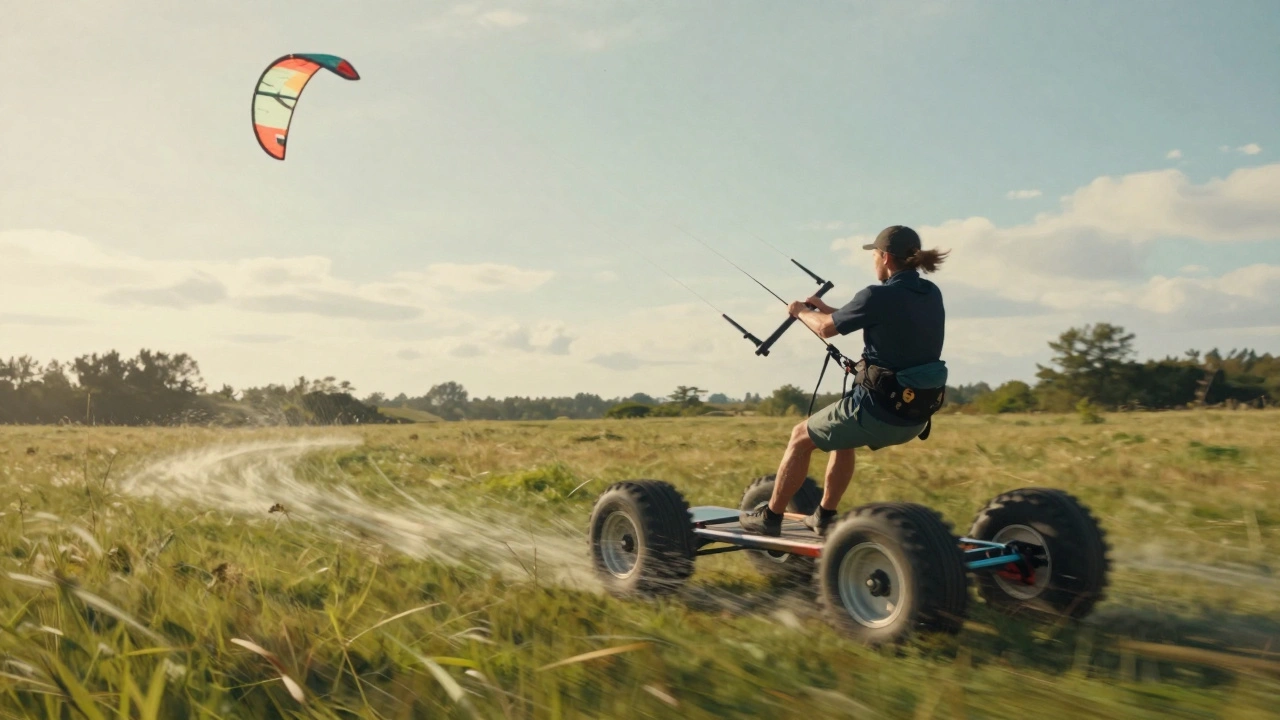
Landboarding is what happens when you take a kiteboard and put wheels on it. Think of it as a skateboard or longboard with oversized wheels-usually 8 to 10 inches tall-designed to roll over grass, dirt, and gravel. The board is shorter than a water board, with a stance similar to snowboarding. You strap in with foot straps or bindings, hold the kite bar, and let the wind pull you forward.
Landboarding demands more balance than buggying. You’re standing. You’re shifting your weight. You’re carving turns like a surfer. That makes it harder to learn but way more fun once you get the hang of it. You can do slides, jumps, and even ride small ramps if you find them. It’s the most like water kiteboarding in feel-just without the splash.
Most landboards have 3 to 5 wheels. Some use a single rear wheel and two front wheels for better turning. Others use a 4-wheel setup for stability. The wheels are made of hard rubber or polyurethane to handle rough terrain. You’ll need a kite size between 7m and 12m depending on wind speed. Smaller kites are better for beginners because they’re easier to control.
Brands like Ozone a kite brand that produces landboarding-specific kites and Duotone a brand offering landboarding boards and kite systems make gear designed specifically for this. You can also convert a water kiteboard by adding wheel kits, but dedicated landboards are built sturdier and wider for better grip.
Best places to landboard: large grassy fields, golf courses (when empty), dry riverbeds. Avoid pavement-it’s too hard on wheels and too slippery. A slightly soft surface gives you traction without slowing you down.
Mountain Boarding: The Aggressive Cousin
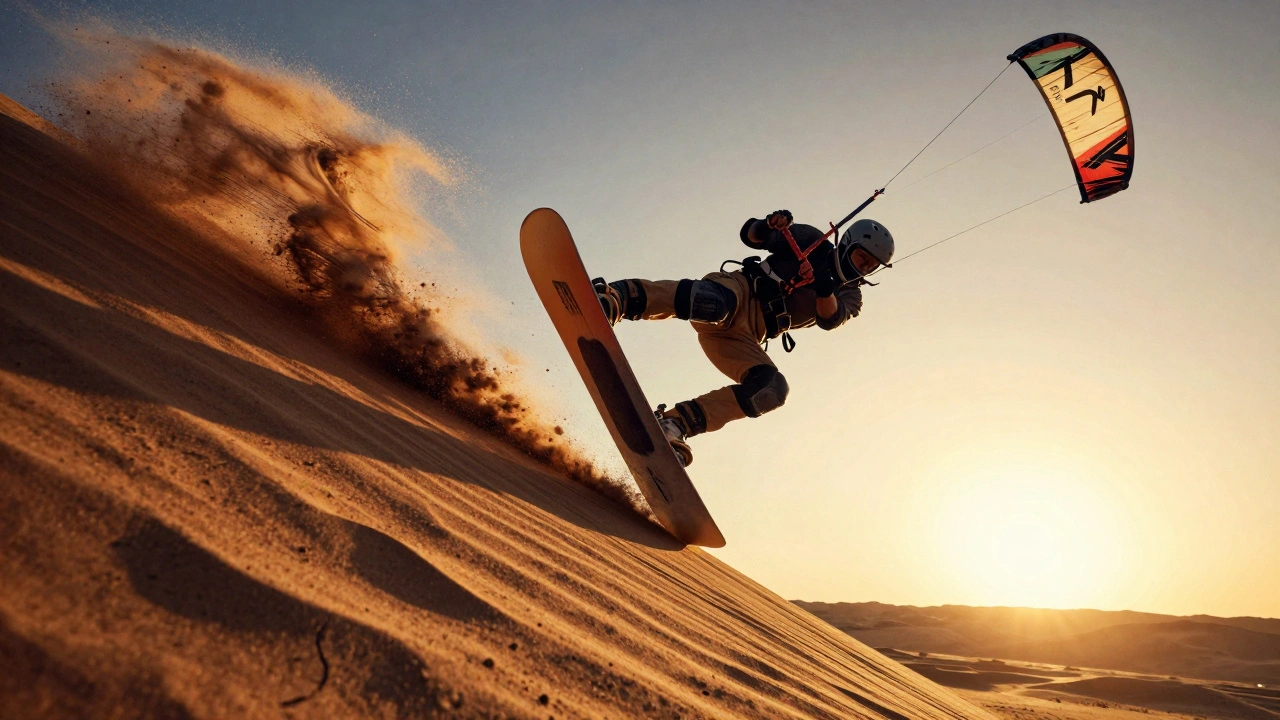
Mountain boarding is the adrenaline version of land kiteboarding. It’s like snowboarding on dirt, but with a kite pulling you uphill as well as down. The board is wider, stiffer, and has larger wheels than a landboard-sometimes over 12 inches. You wear a full-face helmet and knee pads. This isn’t for casual riders. This is for people who want to ride steep hills, jump off banks, and launch into the air.
Mountain boarding usually uses a 4-line kite for maximum control. The kite is flown in a figure-eight pattern to generate power and lift. You can ride down a 30-degree slope, then use the kite to pull yourself back up. That’s the magic trick: you’re not just riding with the wind-you’re using it to climb.
Most mountain boards have independent suspension, like a mountain bike. The wheels are knobby for grip on loose soil. Riders often use 10m to 14m kites because they need more power to pull them up hills. It’s physically demanding. You’re constantly shifting your weight, edging the board, and managing kite lines while going downhill at 40 mph.
Popular mountain board brands include MBS a company specializing in mountain boarding equipment and Kode a brand known for rugged, high-performance boards. These boards cost $800 to $1,500 alone, not counting the kite. It’s the most expensive form of land kiteboarding-but also the most thrilling.
Best places: mountainous areas with open slopes. The Cascades in Oregon, the Wasatch Range in Utah, and the Rockies in Colorado are hotspots. You need space, elevation, and wind. Not every hill works. Look for wide, open slopes with minimal trees and rocks.
How to Get Started
Starting land kiteboarding doesn’t require a big budget, but it does require safety. You need a kite, a board or buggy, a harness, a helmet, and gloves. A beginner setup can cost between $1,000 and $2,500, depending on what you choose. The cheapest entry point is landboarding with a used 9m kite and a secondhand board.
Here’s how to begin:
- Take a kite safety course. Wind can be dangerous. Learn how to relaunch, depower, and self-rescue.
- Start in 10-15 mph winds. Too much wind = bad first experience.
- Practice kite control on the ground first. Fly the kite in a figure-eight pattern until you can hold it steady.
- Use a trainer kite (2-3m) if you’re new to kites. They’re cheap, safe, and teach you the basics.
- Choose your gear based on terrain. Buggying for flat land. Landboarding for grass. Mountain boarding for hills.
- Never ride near roads, power lines, or crowds. Wind doesn’t care where you are.
Many local kiteboarding clubs offer demo days. In Portland, the Columbia Gorge Kite Club a regional group that hosts land kiteboarding events lets newcomers try gear for free. Check their calendar. You’ll learn more in one afternoon than in a month of YouTube videos.
Why Land Kiteboarding Is Growing
Water kiteboarding needs wind and water. Land kiteboarding just needs wind and space. That’s why it’s booming in places with lots of open land but no ocean. In the Midwest, the Great Plains are becoming kiteboarding zones. In the Southwest, desert flats host weekend rallies. Even in cities, large parks and abandoned airfields are getting repurposed.
It’s also cheaper than water kiteboarding. No boat. No wetsuit. No saltwater corrosion. Gear lasts longer. Repairs are easier. You can ride in winter. You can ride after a rainstorm. You don’t need to travel to the coast.
And it’s social. Land kiteboarding communities are tight-knit. You’ll find people sharing tips, trading gear, organizing group rides. It’s not a solo sport. It’s a tribe.
What You Need to Know Before You Ride
Land kiteboarding isn’t as risky as water kiteboarding, but it’s still dangerous if you’re careless. Here are the top 5 things to remember:
- Wind direction matters. Always ride perpendicular to the wind. Never ride directly into it or directly downwind.
- Check your lines. Tangled lines can snap and cause injury. Always inspect before each session.
- Use a helmet and pads. Falls happen. Even at low speed.
- Know your limits. If you can’t control the kite, stop. Don’t push into stronger wind.
- Respect the land. Ride on public land where allowed. Avoid protected areas, wildlife zones, and private property.
Most injuries happen in the first 10 rides. That’s why training is non-negotiable. Even experienced kiteboarders take a refresher course every year. The wind doesn’t forgive mistakes.
Final Thoughts
Land kiteboarding isn’t a replacement for water kiteboarding. It’s a parallel universe. One where you can ride in February, in the snow, with your boots on. Where you don’t need to drive three hours to find waves. Where the only thing between you and the wind is a patch of open ground.
Whether you choose the speed of a buggy, the flow of a landboard, or the chaos of a mountain board, you’re still riding the same force: wind. And that’s what makes it magic.