
You probably think of kites as toys for windy afternoons or festival decorations. But look closer at the history of kites and you will find one of the most powerful, low-cost teaching tools ever invented. Before textbooks were cheap and before every school had a computer lab, teachers used string and wind to explain gravity, lift, drag, and electricity. This isn't just nostalgia; it is a proven method that turns abstract physics into something you can feel in your hands.
The Ancient Classroom: China and the First Lessons
Most people know kites originated in China around 500 BC, attributed to Mozi and Lu Ban. But few realize how quickly they moved from military signaling devices to educational instruments. In ancient Chinese academies, constructing a kite was a lesson in geometry and material science. Students learned about balance by adjusting the bridle points on bamboo frames. They understood aerodynamics not through equations, but by watching which shapes stayed aloft and which crashed.
This hands-on approach laid the groundwork for what we now call experiential learning. By building their own kites, students internalized concepts like center of pressure and stability. If the tail was too short, the kite spun out of control. If the sail area was insufficient, it wouldn't lift. These immediate feedback loops made complex physical laws intuitive. It wasn't until centuries later that this practical knowledge traveled west along trade routes, eventually landing in Europe where it would change scientific history forever.
Benjamin Franklin and the Spark of Electricity
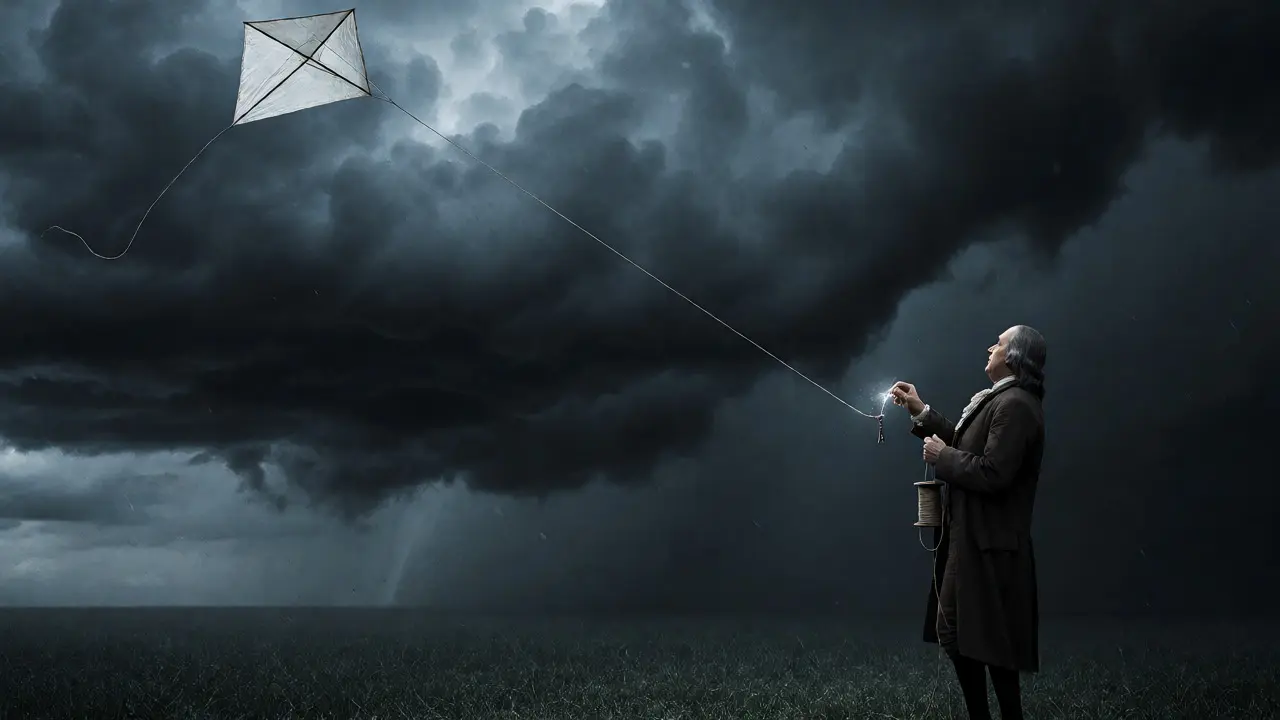
You cannot talk about kites in education without mentioning Benjamin Franklin. His famous 1752 experiment is often misunderstood. Did he really get struck by lightning? Probably not directly, or he would have been dead. Instead, he used a kite to prove that lightning is electrical. He flew a silk handkerchief kite in a storm, attaching a metal key to the string. When he brought his knuckle near the key, sparks jumped. This demonstrated that clouds contained electric charge.
Franklin didn't do this just for fun. He did it to teach. At the time, electricity was a parlor trick for the wealthy. Franklin wanted to show that natural phenomena followed universal laws. His kite became a symbol of empirical science. Today, when schools recreate the Franklin experiment (safely, with indoor static generators), they aren't just celebrating an American icon. They are teaching students how to form a hypothesis, test it, and observe results. The kite serves as the bridge between theoretical curiosity and tangible proof.
Victorian Schools and the Aerodynamics Craze
Fast forward to the late 19th century. Kite flying exploded in popularity across Britain and America. This wasn't just a hobby; it became a serious educational trend. Teachers noticed that students who built kites struggled less with math problems related to angles and forces. Why? Because they had physically manipulated these variables.
Schools began integrating kite-making into the curriculum. Textbooks from 1890 describe lessons where students calculated lift-to-drag ratios using simple weights and strings. The Box Kite, invented by Lawrence Hargrave in 1893, was particularly useful in classrooms. Its cellular structure allowed students to see how adding cells increased lift without increasing weight proportionally. This visual demonstration helped many young minds grasp the concept of efficiency in engineering long before they encountered jet engines or wind turbines.
Modern STEM Applications: From Playground to Lab
In today's STEM-focused schools, kites remain relevant. They are affordable, require no batteries, and work outdoors. Modern educators use them to teach data collection. A student might fly a kite with a small camera attached, measuring altitude and speed. They then plot these variables on graphs, learning about correlation and causation.
Consider the difference between reading about air resistance and feeling it. When you hold a spool of line while a strong gust pulls against you, you understand force vectors. You feel tension. This kinesthetic learning sticks. Research from the National Science Foundation suggests that students retain up to 75% more information when they engage in "practice by doing" compared to passive listening. Kites offer that practice in its purest form.
Why Kites Still Beat High-Tech Simulations
You might ask: why use a kite when we have flight simulators? Simulators are great, but they lack chaos. Real wind is unpredictable. It teaches adaptability. A simulator gives you perfect conditions; a kite teaches you to read the sky. You learn to spot thermals, judge cloud movement, and adjust your stance. These soft skills-observation, patience, problem-solving-are hard to code into software.
Moreover, kites democratize science. Not every school has a robotics kit budget. But almost every school can afford tissue paper, glue, and dowels. This accessibility ensures that students from all socioeconomic backgrounds can participate in high-level scientific inquiry. It levels the playing field, making complex physics accessible to a six-year-old and a sixteen-year-old alike.
| Feature | Kite Flying | Flight Simulator | Textbook Diagram |
|---|---|---|---|
| Cost per Student | $5 - $15 | $50+ (hardware/software) | $0 (if shared) |
| Physical Engagement | High (kinesthetic) | Low (visual/auditory) | None |
| Real-world Variables | Unpredictable wind | Programmed scenarios | Static idealization |
| Concept Retention | High (experiential) | Moderate | Low (passive) |

Practical Tips for Educators and Parents
If you want to bring this history into your classroom or backyard, start simple. Don't buy a pre-made stunt kite. Have students build a diamond-shaped kite. It’s forgiving and easy to repair. Use lightweight materials like ripstop nylon or even plastic bags. Focus on the process, not just the flight.
- Step 1: Discuss the parts. What does the spine do? Why do we need a tail?
- Step 2: Build together. Measure twice, cut once. This reinforces precision.
- Step 3: Fly it. Let them fail. Does it crash? Ask why. Was the bridle point wrong? Was the wind too weak?
- Step 4: Iterate. Adjust and try again. This mirrors the scientific method.
For older students, introduce measurement. Attach a lightweight altimeter or use trigonometry to calculate height based on string length and angle. Suddenly, the kite becomes a tool for applied mathematics.
Frequently Asked Questions
Did Benjamin Franklin actually discover electricity with a kite?
No, he did not discover electricity itself, which was known before him. He used the kite to prove that lightning is a form of electricity. His experiment demonstrated that electrical charge exists in the atmosphere, bridging the gap between laboratory static electricity and natural phenomena.
Why are kites considered good educational tools?
Kites provide immediate, tangible feedback on physical principles like lift, drag, and gravity. They allow students to manipulate variables (shape, weight, bridle) and observe results instantly, fostering experiential learning that is often more effective than passive study methods.
What age group benefits most from kite-based science lessons?
Children as young as five can benefit from basic construction and observation, while middle and high school students can use kites for advanced topics like trigonometry, meteorology, and aerodynamic efficiency. The simplicity of the tool allows it to scale with the learner's complexity level.
How much does it cost to set up a kite science program?
It is extremely low-cost. Materials for a class set of homemade kites (bamboo skewers, string, plastic sheeting) typically cost under $20 total. This makes it accessible for underfunded schools compared to expensive digital simulations or lab equipment.
Can kites be used to teach subjects other than physics?
Yes. Historically, kites taught geography (wind patterns) and history (cultural significance). Today, they can be used in art classes for design aesthetics and in environmental science to discuss renewable energy sources, such as airborne wind energy systems.