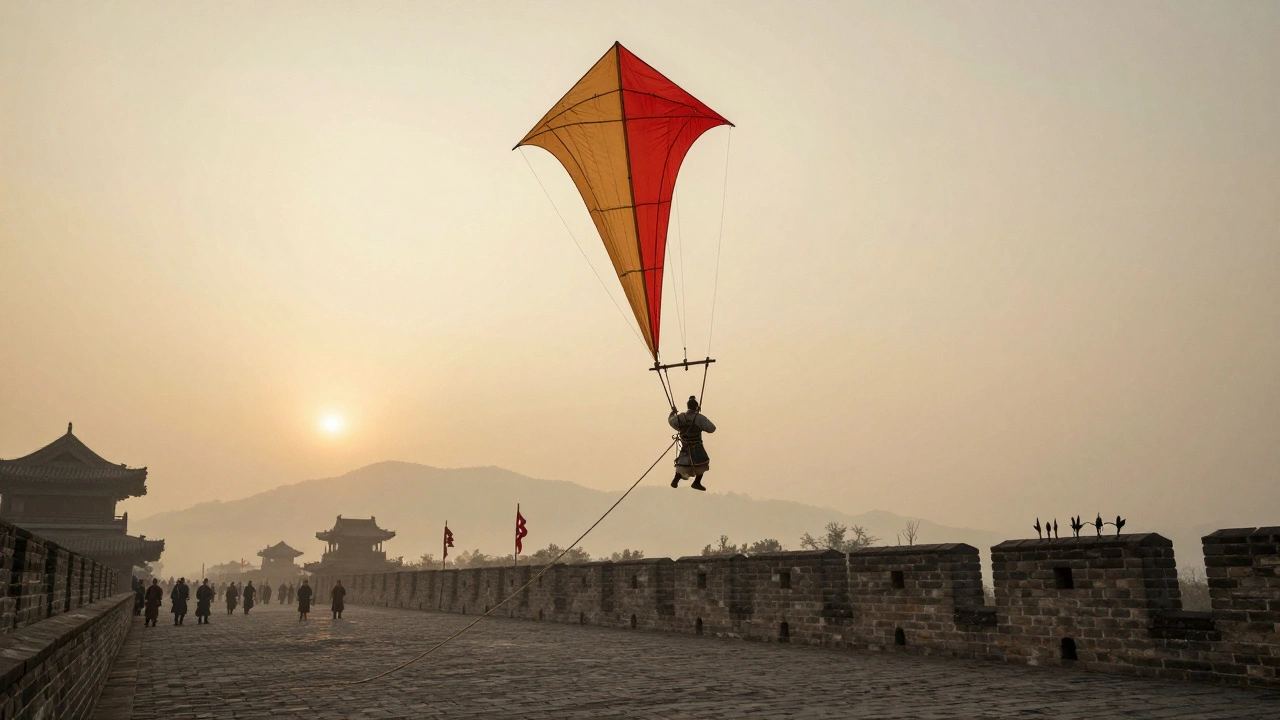
Most people think of kites as children’s toys, fluttering in spring breezes on park lawns. But centuries ago, kites weren’t just for fun-they were weapons, messengers, and spies. In ancient warfare, kites weren’t decorative. They were tactical. From China to Japan, from India to the Middle East, armies used kites to gain advantage in ways most history books barely mention.
China’s First War Kites: The Birth of Aerial Reconnaissance
The earliest recorded use of kites in warfare comes from China, around 200 BCE during the Han Dynasty. General Han Xin, fighting against the Kingdom of Zhao, needed to know what was happening inside enemy walls. Instead of sending scouts, he ordered his men to build a giant kite large enough to carry a man. The kite was tied to a long hemp rope and flown over the city. A soldier, strapped into a harness beneath it, floated above the walls to observe troop movements, gate locations, and guard rotations. The mission succeeded. The enemy had no idea they were being watched from above.
This wasn’t just luck. Chinese engineers had already mastered kite design. They used bamboo frames, silk or paper sails, and tail stabilizers. These weren’t flimsy playthings-they were engineered for wind resistance and control. By 500 CE, kite-making was so advanced that the military kept specialized kite units. These weren’t just builders; they were trained in aerodynamics, weather patterns, and signal coding.
Signal Kites: Silent Communication Over Long Distances
Before radio, before telegraphs, armies needed ways to send messages across mountains, rivers, and battlefields. Kites became the answer. In the 7th century, Chinese troops used kites to carry coded messages. A small bamboo tube, sealed with wax, was tied beneath the kite. Inside: written orders, troop positions, or warnings. The kite was flown at dawn or dusk, when winds were steady and visibility high. Ground crews watched from miles away, noting the kite’s position, color, and tail movement-each combination meant something different.
One documented example comes from the Tang Dynasty. During a siege, a general sent a kite with a message: "Enemy water supply cut. Attack at third watch." The kite flew over 15 miles in under an hour. The attack succeeded. No runners were captured. No messengers were ambushed. Just a silent kite in the sky.
Psychological Warfare: Kites as Fear Weapons
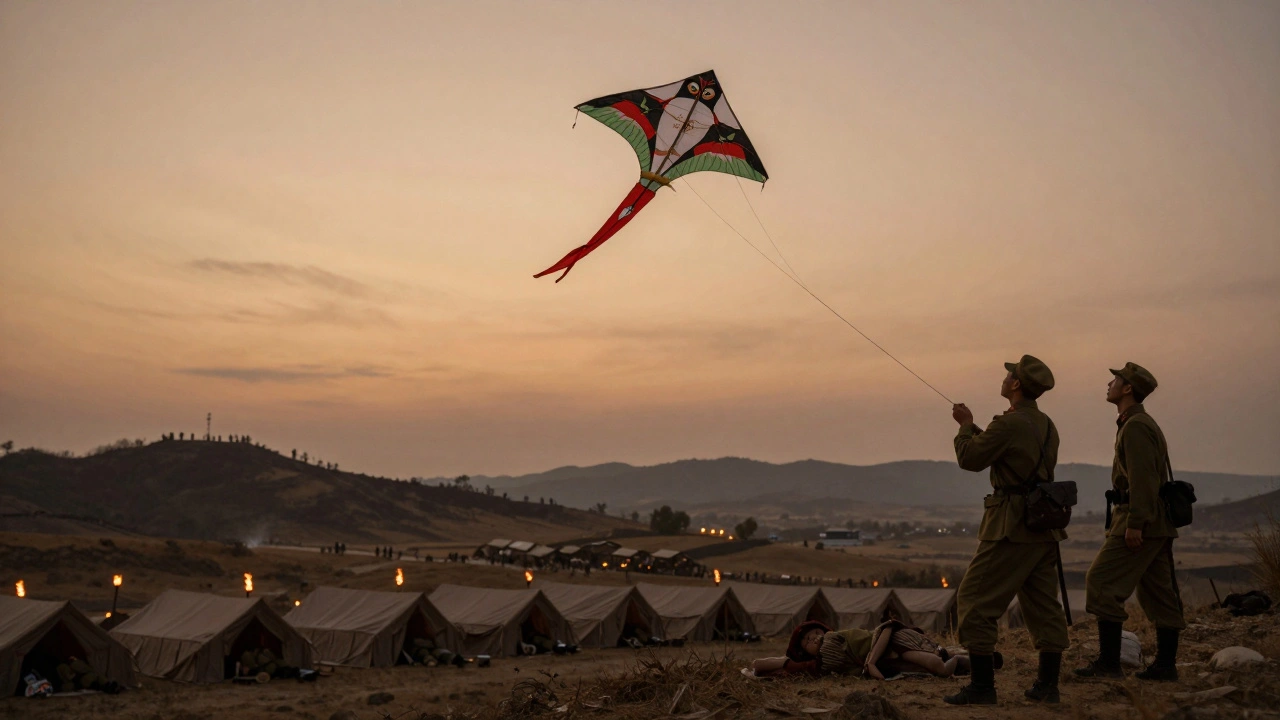
Kites didn’t just carry messages-they scared people. In the 13th century, Mongol forces under Genghis Khan’s generals used kites to spread panic. They attached loud whistles or metal plates to kite tails. When flown over enemy camps at night, the wind made eerie, howling sounds. Soldiers thought it was spirits or demons. Some deserted. Others refused to sleep. The psychological effect was real. No arrows were fired. No swords drawn. Just wind and silk, and the power of fear.
Japanese samurai did something similar during the Sengoku period. They flew kites shaped like demons or dragons over enemy positions. These weren’t just scary-they were decorated with painted eyes, roaring mouths, and blood-red silk. One 1572 account from a Kyoto chronicle describes how a castle garrison surrendered after three nights of "flying monsters" circling their walls. The attackers never climbed a single ladder.
Kites as Surveillance and Measurement Tools
Before drones, before satellites, kites were the only way to see over hills or measure distances. In the 10th century, Chinese military surveyors used kites to map enemy terrain. They attached a weighted line to a kite and flew it over a valley. When the line touched the ground, they measured the length of rope paid out. That gave them the exact height difference between two points. They could calculate slope angles, river depths, and bridge spans-all from the ground.
During the Song Dynasty, kite-based surveying became standard. Armies carried portable kite kits with calibrated ropes and wind gauges. One field manual from 1150 describes how a kite team could map a 5-mile stretch of enemy border in under two hours. That same terrain would have taken a foot patrol three days to cross and map.
India and the Middle East: Kites in Siege Warfare
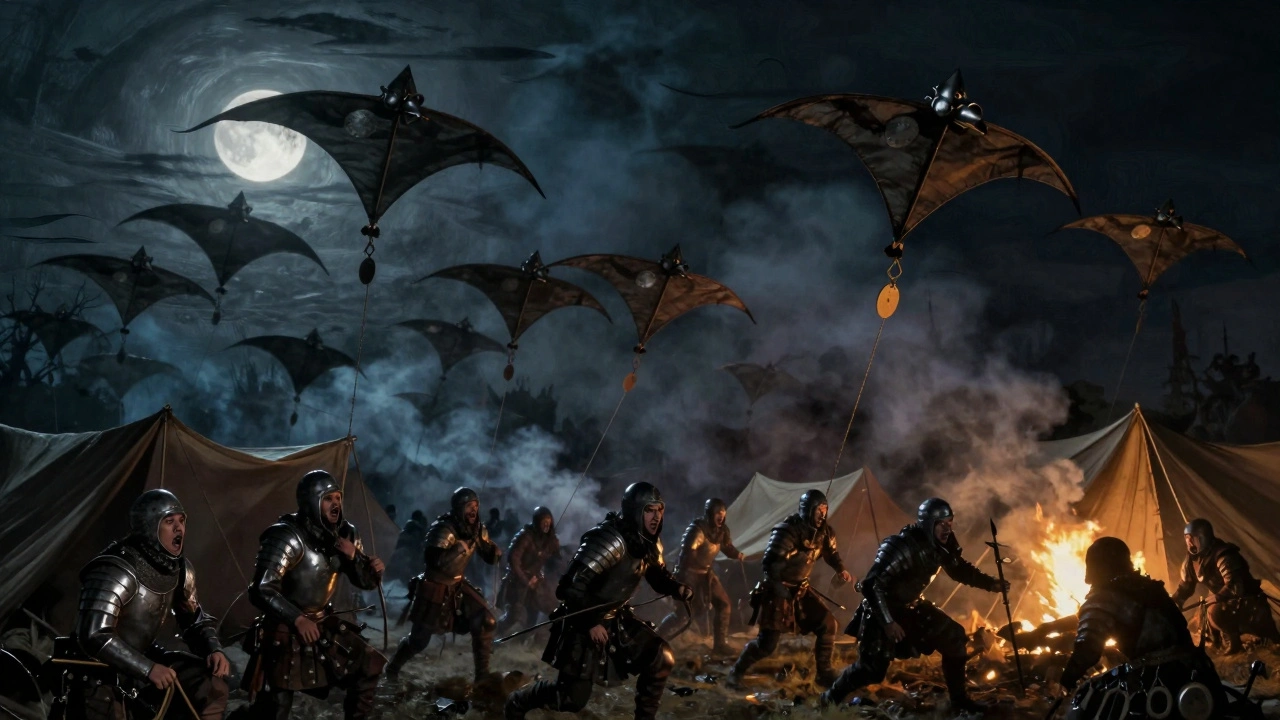
The use of kites wasn’t limited to East Asia. In 14th-century India, Rajput armies used kites to drop burning tar and oil onto enemy siege towers. The kites carried small clay pots filled with flammable material. When released over the towers, the pots shattered on impact. Fire spread quickly. Wooden structures burned. The tactic was especially effective during monsoon season, when wind was strong and rain couldn’t douse the flames.
In the Middle East, Persian and Arab forces experimented with kite-based espionage. A 12th-century manuscript from Baghdad describes how kites were used to carry mirrors that reflected sunlight into enemy camps. The flashes signaled troop movements. Some accounts say these signals were timed to coordinate with cavalry charges. It’s unclear if the technique was widely adopted, but the idea was clearly understood: light, wind, and silence could change the outcome of a battle.
Why Did Military Kites Fade Away?
By the 18th century, kite warfare declined. Why? Two reasons: gunpowder and technology. As cannons became more accurate, flying a kite over enemy lines became suicide. A single shot could bring it down. Also, balloons and later, telegraphs, offered better alternatives. Kites were slow. They depended on wind. They couldn’t carry heavy payloads.
But they didn’t disappear. In 1903, the U.S. Army Signal Corps tested kite-based radio antennas during maneuvers in Virginia. The kites lifted wires over 1,000 feet to establish communication lines. They worked. And in World War I, British and German forces used kites to lift observation balloons. The principle was the same: use the wind to gain height, then see what the enemy couldn’t.
Modern drones have replaced kites. But the idea? That’s unchanged. Kites taught us that the sky is a battlefield. And sometimes, the simplest tool-the one made of paper and bamboo-can change the course of war.
Did ancient armies really use kites to spy on enemies?
Yes. Historical records from China, Japan, and India describe kites being used to carry soldiers or observers above enemy walls. The Han Dynasty general Han Xin used a human-carrying kite to gather intelligence during a siege in 200 BCE. These weren’t myths-they were documented military operations.
How did kites communicate messages without words?
Kites used visual codes. Colors, tail length, number of tails, flight height, and movement patterns all had meaning. For example, a red kite with three tails might mean "enemy reinforcements approaching." A kite flown low and slow could signal "attack at dawn." Ground observers, trained in these codes, interpreted the signals without needing to read text.
Were kites used in battles outside of China?
Absolutely. Indian armies dropped fire pots from kites during sieges. Persian forces used reflective kites to send light signals. Japanese samurai flew demon-shaped kites to frighten enemy troops. These weren’t isolated incidents-they were part of regional military traditions across Asia and the Middle East.
Could a kite really carry a person?
Yes. Historical texts describe kites strong enough to lift a single soldier. Bamboo frames, reinforced silk, and long hemp ropes made it possible. In 200 BCE, Han Xin’s team flew a man over a city wall using a kite. Modern recreations using ancient designs have confirmed this is physically possible with the right wind conditions and materials.
Why aren’t kites used in modern warfare?
Modern drones are faster, more reliable, and can carry cameras, sensors, and weapons. Kites depend on wind, can’t hover, and are vulnerable to gunfire. But the concept lives on-modern military UAVs still use the same principle: gain altitude, observe, and communicate. Kites were the first step.