Imagine standing on a hill in modern-day Portland, watching a colorful diamond-shaped toy dance against the gray sky. It feels like pure leisure, right? But that string attached to your hand connects you to one of humanity’s oldest engineering feats. The kite is not just a toy; it is a technological artifact that traveled thousands of miles, changing form and function as it moved across continents. Most people assume kites started as simple children's games, but their journey began with military strategy, religious ritual, and scientific curiosity.
The story of how kites spread from China to the rest of the world is a masterclass in cultural diffusion. It wasn’t a single event but a slow, centuries-long migration along trade routes, carried by monks, merchants, and soldiers. If you’ve ever wondered why Japanese kites look so different from Indian ones, or why Benjamin Franklin used a key in a storm, this timeline breaks down exactly how a piece of silk and bamboo conquered the globe.
The Birthplace: Ancient China and Military Origins
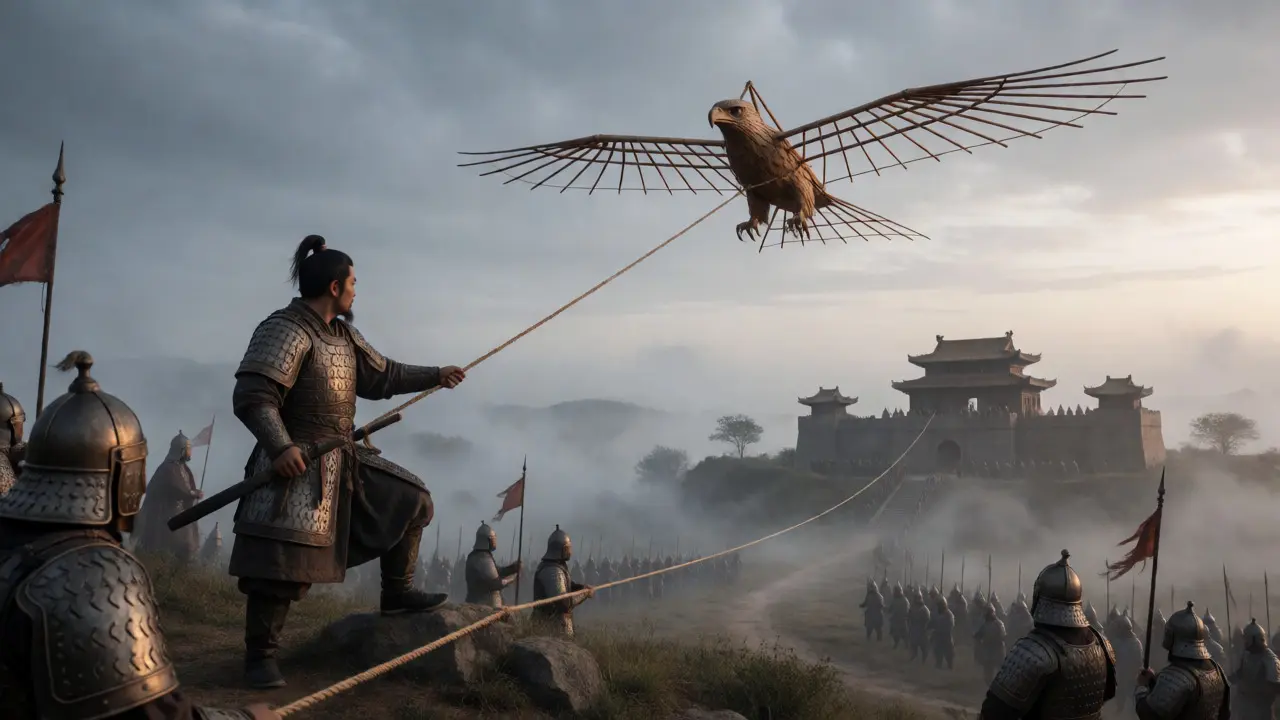
Historical consensus places the invention of the kite in China around the 5th century BCE. While legends credit philosophers Mozi and Lu Ban, archaeological evidence points to practical applications long before they became recreational items. Early Chinese kites were made from wood, specifically paulownia or bamboo, because paper hadn't been invented yet. These weren't lightweight flyers; they were heavy, rigid structures designed for specific tasks.
The primary use case was military. General Han Xin reportedly used kites to measure distances for tunneling under enemy walls during the Chu-Han Contention. By attaching a kite to a string and flying it at a known height, he could calculate the length of rope needed to dig a tunnel to emerge inside the fortress. This demonstrates an early understanding of geometry and aerodynamics. Later, kites served as signaling devices, carrying messages or even fire arrows into battle. The shape was often bird-like, mimicking hawks or eagles, which tied into Taoist beliefs about spirits and the afterlife.
As paper technology advanced during the Han Dynasty (206 BCE - 220 CE), kites became lighter and more accessible. Bamboo frames replaced solid wood, allowing for larger surface areas and better lift. This shift marked the transition from purely military tools to objects of cultural significance. During the Tang Dynasty, kite flying became a popular pastime among the aristocracy, who decorated them with intricate paintings of dragons and phoenixes. The structure remained consistent: a cross-shaped frame covered in silk or paper, balanced by a tail to prevent spinning.
Migration Across Asia: Religion and Ritual
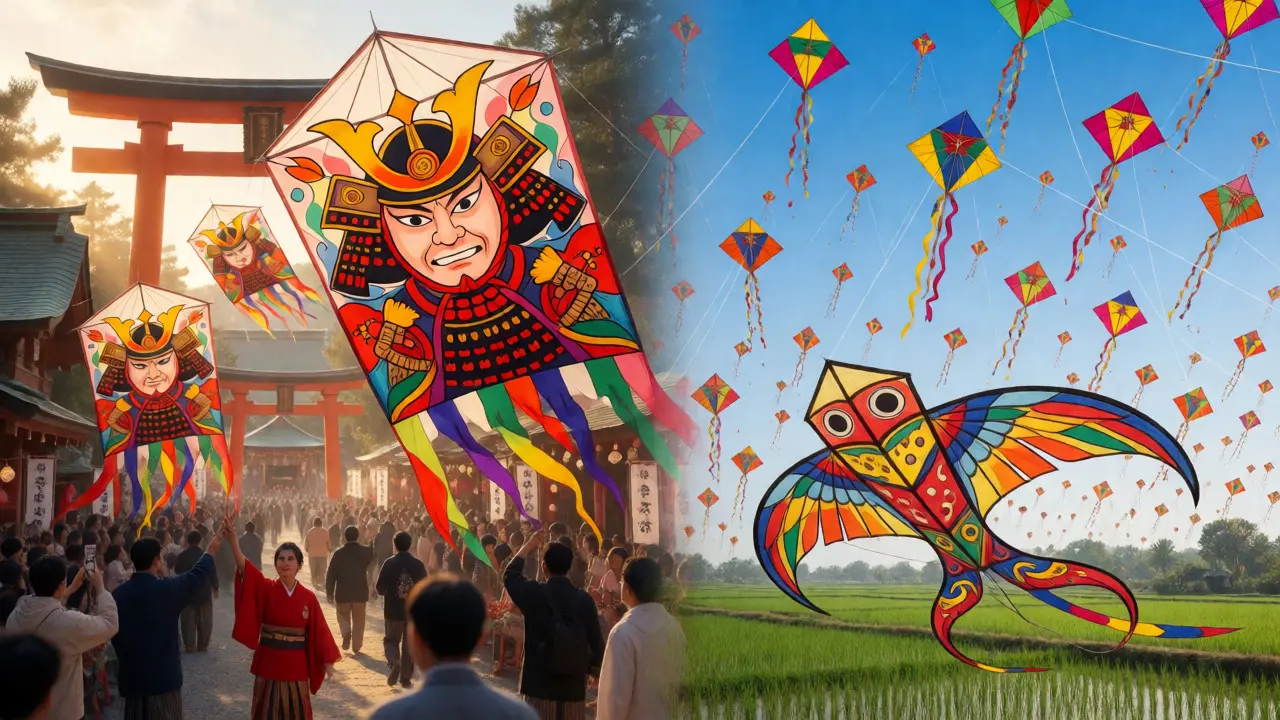
Kites didn’t stay in China. As Buddhism spread eastward and southward, so did the technology. In Japan, kites arrived via Buddhist monks and diplomatic missions around the 7th century. Here, they evolved differently. Japanese kites, known as tako, became deeply intertwined with Shinto rituals and seasonal festivals. Unlike the delicate Chinese designs, Japanese kites often featured bold, graphic patterns-samurai faces, kabuki actors, or mythological creatures-and were flown during New Year celebrations to ward off evil spirits.
In Southeast Asia, particularly in Thailand and Malaysia, kites took on agricultural roles. Farmers flew large, heavy kites called Wau Bulan (Moon Kites) in Malaysia to scare birds away from rice paddies. These kites were engineered for stability rather than agility, featuring curved wings that generated significant lift. The design reflects local aesthetics, with crescent shapes symbolizing the moon and vibrant colors representing harvest abundance. This adaptation shows how the core technology was tweaked to fit local environmental and economic needs.
India developed its own distinct tradition, heavily influenced by Hindu mythology. Kites became central to the festival of Makar Sankranti, where the sky fills with thousands of flyers. Indian kites are typically smaller, diamond-shaped, and made from tissue paper and bamboo. The focus here isn’t on complex maneuvers but on competition-cutting other kites’ strings using glass-coated thread (manja). This martial aspect echoes the original Chinese military roots, showing a fascinating parallel evolution despite geographic separation.
The Silk Road and Westward Expansion
The westward movement of kites followed the same paths as spices and silk. Arab traders likely encountered kites in Central Asia and Persia between the 9th and 13th centuries. Persian miniatures from this era depict figures flying kite-like objects, suggesting they were used for entertainment and possibly communication. From the Middle East, the concept trickled into Europe through two main channels: returning Crusaders and later, Venetian merchants.
Europeans initially viewed kites with skepticism. Early European records describe them as "dragons" or "devils" due to their strange appearance and silent flight. However, the utility of kites quickly won over scientists and explorers. By the 16th century, kites appeared in Dutch and English art, often depicted as toys for nobility. The materials changed too; Europeans lacked access to high-quality Chinese silk and instead used linen or parchment. This material constraint led to heavier, less efficient designs until the industrial revolution provided cheaper textiles.
| Region | Primary Material | Traditional Use | Design Feature |
|---|---|---|---|
| China | Silk/Bamboo | Military/Signaling | Bird-shaped, rigid frame |
| Japan | Paper/Washi | Religious/Festival | Bold graphics, rectangular |
| India | Tissue Paper | Competition/Harvest | Diamond shape, light weight |
| Europe | Linen/Cotton | Scientific/Recreation | Box/Delta variants later |
Science Takes Flight: The European Revolution
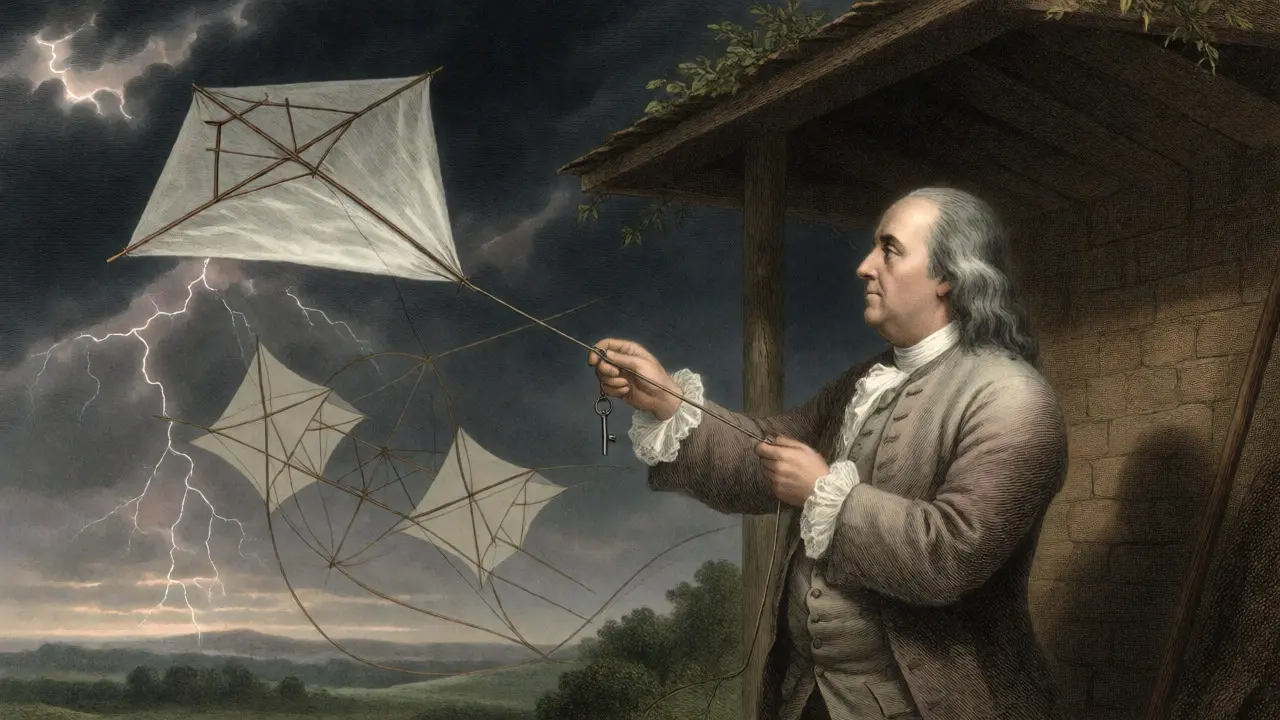
While Asia kept kites rooted in culture, Europe turned them into laboratory instruments. This divergence created the modern understanding of aerodynamics. In 1749, Alexander Wilson used a chain of six kites to measure temperature at different altitudes. This was a direct precursor to weather balloons. Then came Benjamin Franklin’s famous 1752 experiment. He didn’t just fly a kite in a storm; he proved that lightning is electricity. By attaching a metal key to the string and collecting sparks in a Leyden jar, Franklin linked atmospheric phenomena to electrical theory. This moment cemented the kite’s status as a serious scientific tool.
The late 19th century saw the most radical innovation: the box kite. Lawrence Hargrave, an Australian engineer, invented the double-box kite in 1893. His design offered unprecedented lift-to-drag ratios, making it ideal for lifting observers. This technology directly influenced the Wright Brothers. Before their powered flights in 1903, Wilbur and Orville Wright extensively tested gliders based on Hargrave’s box kite principles. Without these stable, controllable kites, the airplane might have taken decades longer to develop. The kite had transformed from a toy to the grandfather of aviation.
Modern Era: Sport and Globalization
The 20th century democratized kite flying. Mass production of nylon and fiberglass replaced fragile paper and bamboo, making kites durable and affordable. Post-World War II, surplus parachutes and aircraft materials fueled a hobby boom in North America and Europe. New disciplines emerged, such as sport kiting (stunt flying) and power kiting. Today, kites are used for everything from fishing (casting bait far out into the surf) to extreme sports like kitesurfing, where riders harness wind power to glide across water at high speeds.
Culturally, kites remain a unifying force. Festivals in Weifang, China, attract millions of visitors annually, showcasing everything from microscopic insects to massive dragon trains spanning hundreds of meters. In Berkeley, California, the annual kite festival draws crowds who celebrate the sheer joy of flight. The technology has diversified, but the core principle remains unchanged since those first wooden birds in ancient China: capture the wind, hold on tight, and look up.
Frequently Asked Questions
Who actually invented the first kite?
Historians generally attribute the invention to the Chinese philosopher Mozi and his disciple Lu Ban in the 5th century BCE. However, some theories suggest earlier forms existed in Southeast Asia. The earliest confirmed kites were made of wood, not paper, and were used for military measurements rather than play.
Why do Indian kites cut each other?
This is part of the competitive tradition during festivals like Makar Sankranti. Flyers coat their strings with a mixture of glue and crushed glass (called manja). The goal is to slice through an opponent's string while keeping your own intact, turning the sky into a battlefield of maneuverability and tension control.
Did Benjamin Franklin really get struck by lightning with his kite?
Not exactly. If he had been struck directly, he likely would have died. Franklin flew the kite in a thunderstorm to collect ambient electrical charge from the air. The key sparked when brought near his knuckle, proving that lightning shares properties with static electricity. It was a dangerous experiment, but not a direct hit.
How did kites influence airplanes?
Kites provided the foundational data for lift and drag. Lawrence Hargrave's box kite design allowed for stable observation platforms, which inspired early aviators. The Wright Brothers used kite-like glider structures to test wing warping and control surfaces before adding engines, effectively treating kites as unmanned prototypes for powered flight.
Are kites still used for military purposes today?
Yes, though in different forms. Modern military uses include tethered aerostats for surveillance radar platforms and drone-like autonomous kites for reconnaissance. Additionally, kites are still used for mine clearance in some naval operations, towing cables to trigger underwater mines safely.