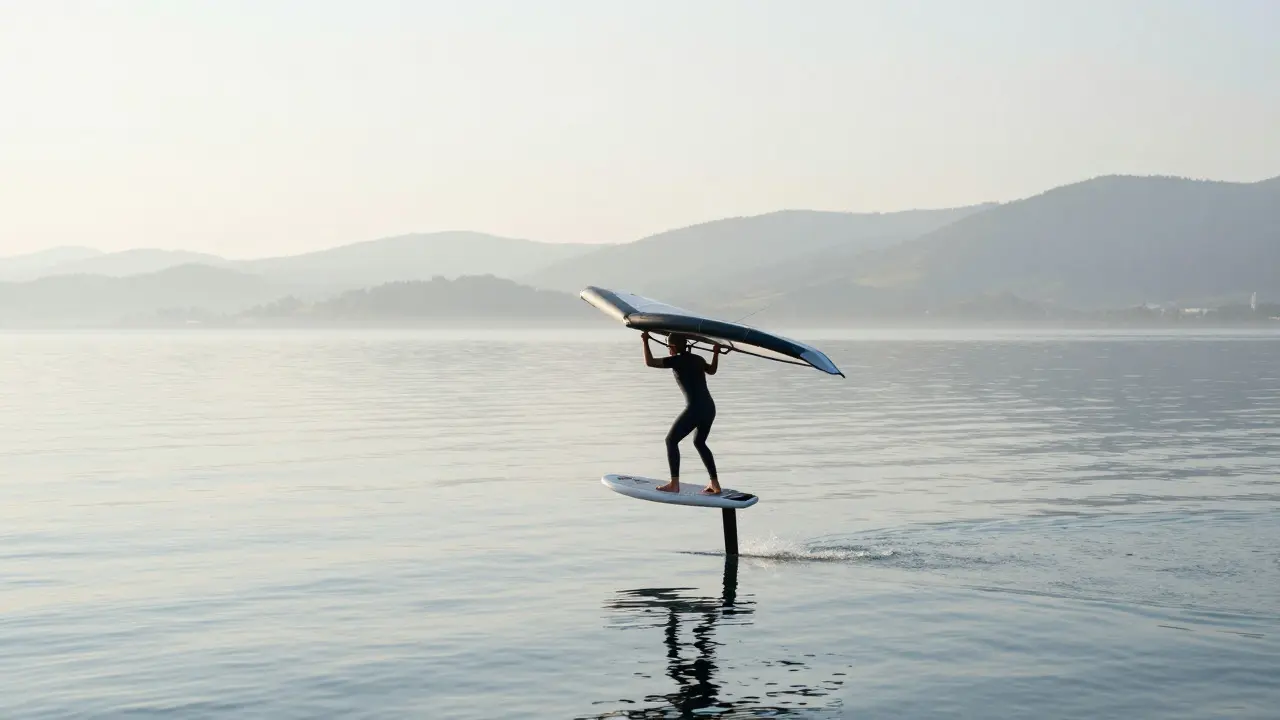
Imagine gliding across a glassy lake at 25 knots with barely any chop. You are hovering above the water on a hydrofoil is a wing-like structure that lifts the rider above the water surface to reduce drag. This technology changes how you interact with the wind. Instead of fighting waves or needing massive gusts, you tap into steady, lighter winds that were previously unusable for standard twin-tip boards.
The core innovation here isn't just the board; it's the synergy between the foil and the kite. Traditional kiteboards rely on planing speed to stay up. If you stop moving, you sink. Foil kiting removes this constraint. Once you generate enough lift, you can hover in place, drift slowly, or turn sharply without losing altitude. This shift from dynamic stability to static lift opens up a new dimension of freedom for riders.
How Foil Kites Differ from Standard Twin-Tips
Most people think of kiteboarding as dragging a board behind them. In foil kiting, the board becomes a platform rather than a sled. The main difference lies in the kite control system is the interface between the rider and the airframe, typically involving a bar and lines. While the physical kite looks similar to those used in wave riding, the way you use it changes drastically. You don't pump the kite to generate power; you manage its angle of attack to maintain lift.
- Wind Range: Foil kites allow you to ride in winds as low as 8-10 knots, whereas standard kites often need 15+ knots to get planing.
- Drag Reduction: By lifting out of the water, you eliminate friction. This means less energy is lost to resistance, so your body feels lighter.
- Maneuverability: Turns are sharper and quicker because you aren't fighting water resistance. You can pivot on a dime if you know how to trim the foil.
This reduction in drag is the primary driver of efficiency. When you are planing on a twin-tip, maybe 30% of your kite's power goes into overcoming water friction. On a foil, that number drops significantly. More power goes into forward motion or vertical lift, making every gust feel stronger and more responsive.
The Physics of Lift and Drift
To understand why foils are so efficient, you have to look at aerodynamics. A wing profile is the cross-sectional shape of the foil wing that determines lift and drag characteristics. Most modern foil wings use asymmetric profiles, similar to airplane wings. These shapes create a pressure differential: lower pressure on top, higher pressure below. This difference generates lift.
Drift is a unique aspect of foil kiting. Unlike surfing, where you must maintain speed to stay on the wave, drifting allows you to move laterally across the water while maintaining altitude. This is achieved by adjusting the angle of the wing relative to the water flow. If you tilt the nose down slightly, you gain speed but lose some lift. If you raise the nose, you increase lift but slow down. Mastering this balance lets you "park" in the water, waiting for a better breeze or simply enjoying the view without sinking.
| Feature | Standard Twin-Tip | Foil Kite Setup |
|---|---|---|
| Minimum Wind Speed | 15-18 knots | 8-12 knots |
| Drag Coefficient | High (water contact) | Low (air/water separation) |
| Turn Radius | Wide (carving required) | Tight (pivot possible) |
| Speed Maintenance | Requires constant pumping | Passive glide possible |
Notice how the minimum wind speed drops dramatically. This isn't magic; it's physics. Because there is no water resistance slowing you down, you need less force from the kite to keep you aloft. This makes light-wind days viable, which is a huge deal for coastal areas like Portland, Oregon, where summer breezes can be inconsistent.
Choosing the Right Foil Components
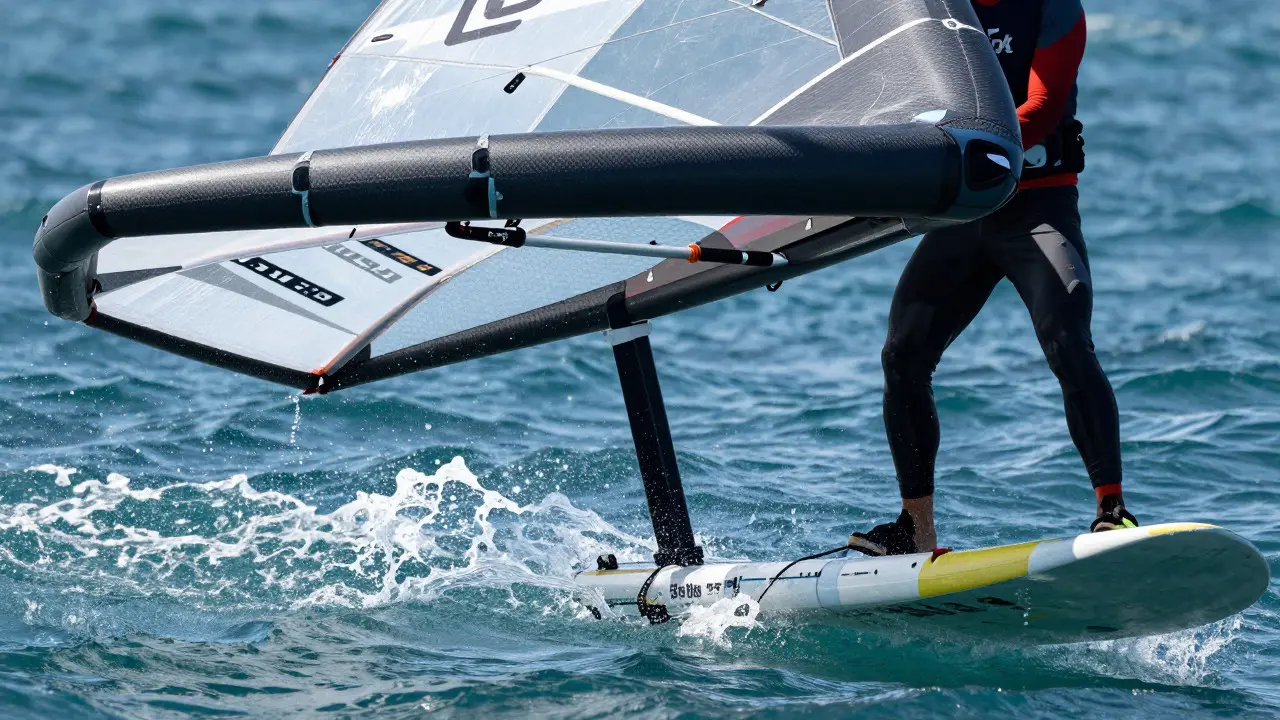
A foil setup consists of three main parts: the mast, the wing, and the board. Each component plays a specific role in your performance. The mast length is the vertical distance between the board deck and the wing, affecting clearance and responsiveness. Shorter masts (around 40-50 cm) offer more responsiveness and easier takeoff but less clearance for jumps. Longer masts (60-70 cm) provide more height for big air but require more speed to stabilize.
The wing size is equally critical. Wing area is measured in square meters. Larger wings (1.2m² and above) generate more lift at lower speeds, making them ideal for beginners or very light wind conditions. Smaller wings (0.8m² to 1.0m²) are faster and more agile but require more skill and wind to stay up. For most intermediate riders, a 1.0m² to 1.2m² wing offers the best balance of forgiveness and performance.
- Beginners: Start with a large wing (1.5m²+) and a short mast. This combination provides maximum lift and stability, reducing the chance of crashing during takeoff.
- Intermediate: Move to a 1.0m² - 1.2m² wing. This allows for faster speeds and better maneuverability while still offering decent lift in moderate winds.
- Advanced: Experiment with smaller wings (0.8m²) and longer masts. This setup is for high-speed cruising and big air tricks.
Don't forget the board. Foil boards are wider and thicker than standard kiteboards. They act as flotation devices when you are not flying. A volume of 100 liters or more is recommended for beginners to ensure easy takeoff. As your skills improve, you can drop to 60-80 liters for a more responsive feel.
Safety and Practical Considerations
Foil kiting is safer than many people think, provided you respect the environment. The biggest risk isn't the kite; it's the ground effect. When you fly close to the water surface, the air layer beneath the wing creates additional lift. This can cause sudden, unexpected rises if you aren't paying attention. Always keep an eye on your altitude, especially when turning downwind.
Another consideration is the landing zone. Foils land softly, but they can tip over easily if you hit them at an awkward angle. Practice landing with both feet flat and knees bent. Avoid landing on rocks or shallow reefs, as the mast can snap if it hits something hard. In places like the Willamette River, always check for submerged hazards before taking off.
Weather matters too. Foils are sensitive to gusts. A sudden burst of wind can spike your altitude rapidly. Learn to depower the kite quickly by pushing the bar away from you. This reduces the angle of attack and lowers lift instantly. Practicing this muscle memory in calm conditions will save you when the weather turns unpredictable.
Efficiency Gains in Real-World Scenarios
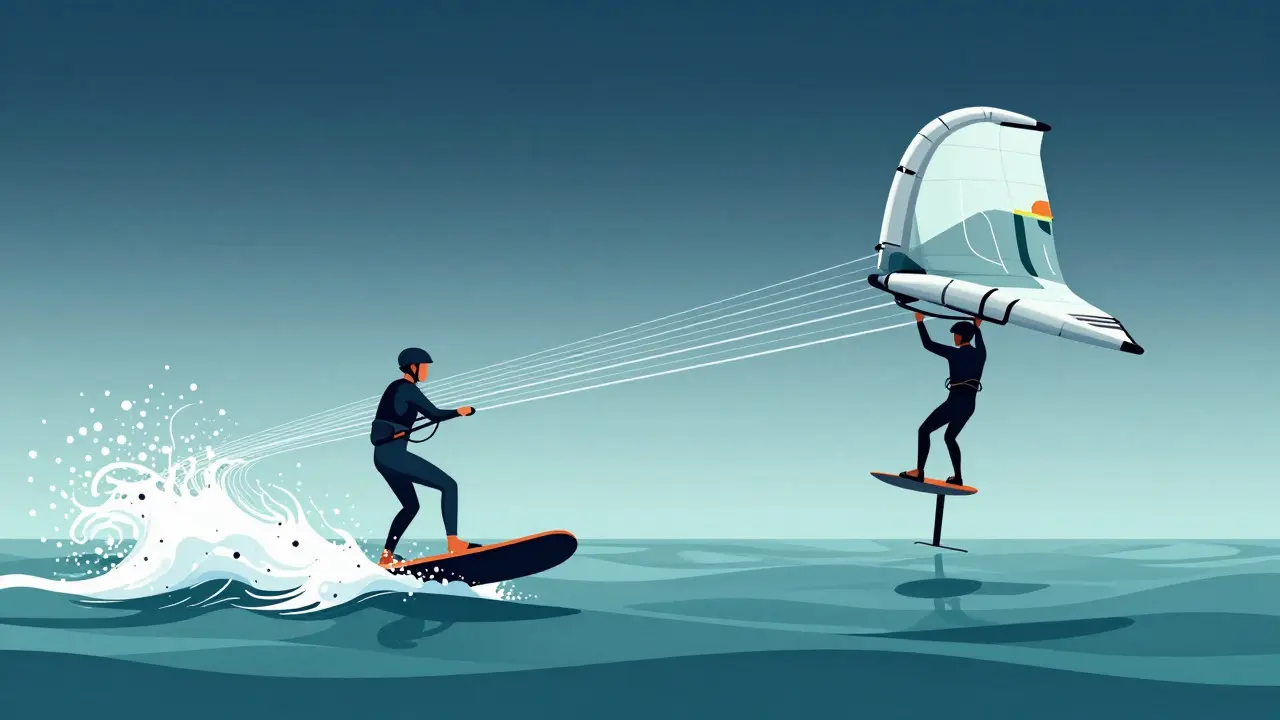
Let's talk about actual riding. On a typical summer day in Portland, winds might hover around 12 knots. On a standard kiteboard, you'd struggle to get up and would spend half your session trying to maintain speed. With a foil, you can launch easily, cruise at a comfortable pace, and even explore areas further from shore that are inaccessible due to shallow water. The reduced drag means you travel further on the same amount of wind energy.
For fitness enthusiasts, foil kiting is surprisingly intense. Your core muscles work constantly to balance the rig. Your legs engage to steer and adjust the foil angle. It’s like doing yoga on water, except you're moving at 15-20 mph. Many riders report improved posture and core strength after just a few months of regular sessions.
Economically, switching to foils can save money in the long run. Because you can ride in lighter winds, you don't need to buy multiple sizes of kites to cover different wind ranges. One medium-sized kite (9-12m) can handle most conditions when paired with the right foil wing. This reduces gear costs and storage space.
Common Mistakes and How to Fix Them
Even experienced riders make mistakes. Here are the most common ones and how to correct them:
- Crashing on Takeoff: Usually caused by pulling the bar too hard too fast. Solution: Ease into the pull. Let the foil build speed gradually before lifting off.
- Oscillating (Pogo Sticking): Happens when the wing is unstable. Solution: Check your wing angle. If it's oscillating, trim the wing to a neutral position and relax your grip on the bar.
- Stalling: Occurs when you turn too sharply or lose speed. Solution: Keep your speed consistent. Avoid abrupt turns until you are fully airborne.
- Getting Tangled: Lines can wrap around the mast. Solution: Ensure your lines are clear before launching. Use a line management system if available.
Patience is key. Learning to foil kite takes time. Don't rush the process. Spend your first few sessions just getting comfortable with the takeoff and landing. Once you can do that consistently, focus on straight-line gliding. Then, add turns. Step by step, you'll find the rhythm.
What is the best wind range for foil kiting?
The optimal wind range for foil kiting is typically between 10 and 25 knots. Below 10 knots, it may be difficult to generate enough lift, especially for heavier riders. Above 25 knots, the increased drag from the air can make control challenging, though experienced riders can handle higher speeds with smaller wings.
Can I use my existing kite for foil kiting?
Yes, most standard C-shaped or bow-shaped kites work well for foil kiting. However, kites with good depower capability are preferred because you need to quickly reduce lift when necessary. Avoid using very small kites designed for heavy winds, as they may not provide enough lift in lighter conditions.
How much does a complete foil kit cost?
A complete beginner foil kit, including board, mast, wing, and hardware, typically ranges from $1,500 to $3,000 USD. Mid-range options start around $2,000, while high-end performance setups can exceed $4,000. Prices vary based on brand, material quality, and wing size.
Is foil kiting harder than traditional kiteboarding?
Initially, yes. The learning curve for takeoff and landing is steeper because you are balancing on a narrow wing. However, once you master the basics, many riders find it easier to ride in light winds and more relaxing than traditional kiteboarding due to reduced physical effort.
Do I need a wetsuit for foil kiting?
It depends on the water temperature. Since you spend more time in the water waiting for wind or practicing takeoffs, a wetsuit is recommended in cool climates like the Pacific Northwest. In warmer regions, a rash guard and board shorts may suffice.