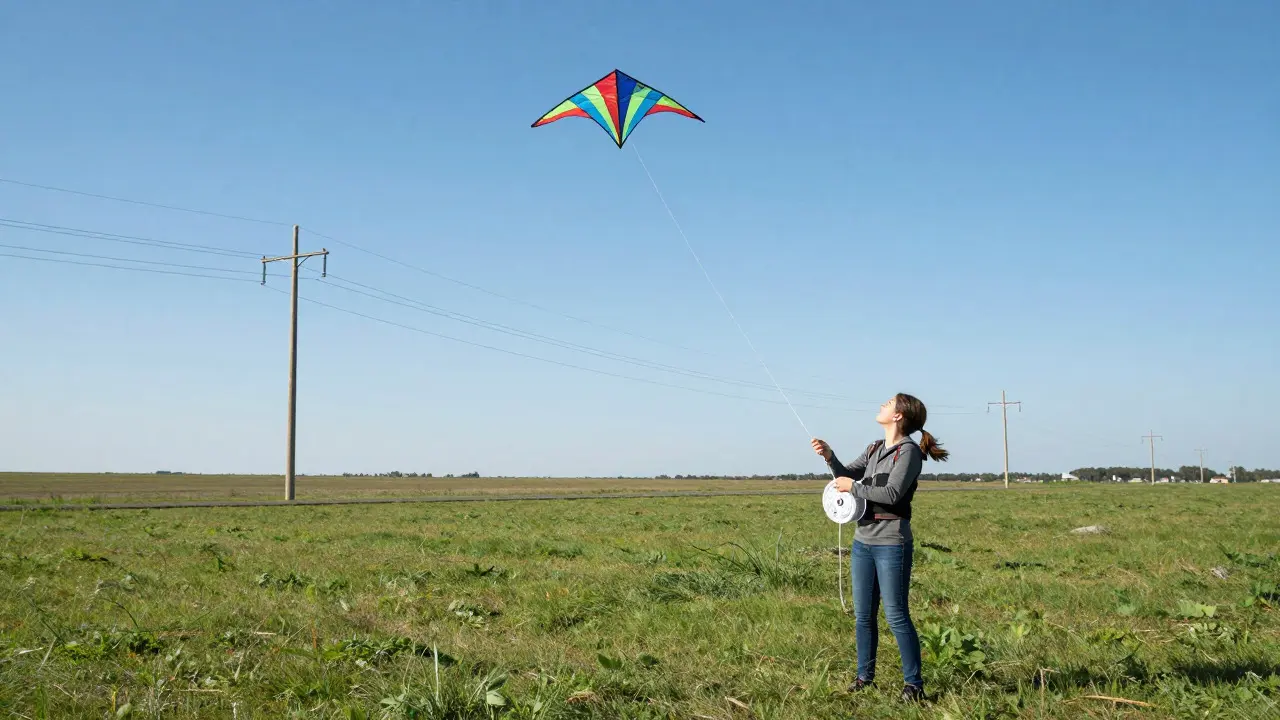
Nothing ruins a sunny afternoon faster than watching your brand-new kite get tangled in a high-voltage wire or snatched by a gusty wind off a busy street. For beginners, the thrill of getting that first diamond or delta kite into the sky often comes with a blind spot: the environment around you. While the kite itself is simple, the kite safety rules governing where you fly it are critical to preventing property damage, personal injury, and expensive repairs.
Most accidents don't happen because of bad luck; they happen because flyers ignore basic spatial awareness. Whether you're in a city park or a rural field, understanding the specific distances required for trees, roads, and power lines turns a risky hobby into a reliable pastime. Here is exactly how to calculate those safe zones before you even unpack your spool.
Understanding the Invisible Danger Zones
Before we look at specific objects, you need to understand how kites behave in different wind conditions. A kite isn't just a piece of fabric; it's an aerodynamic object that reacts instantly to changes in air pressure. When wind speed increases, your kite climbs higher and pulls harder on the line. This means the "safe distance" isn't a static number-it expands as the wind gets stronger.
In light winds (5-10 mph), your kite might stay within 50 meters of your hand. In moderate winds (15-20 mph), it can easily reach 150-300 meters up. In strong winds (25+ mph), it can shoot hundreds of meters into the sky. The rule of thumb? Always assume your kite will go higher and further than you think. If you see a potential hazard, measure the distance conservatively. Better to have too much clearance than not enough.
Power Lines: The Most Critical Hazard
If there is one thing to remember, make it this: keep away from Power Lines is a fixed infrastructure hazard that poses severe electrical risks to kite flyers due to the conductivity of wet lines and debris. Unlike trees or fences, power lines are invisible until you hit them, and the consequences are fatal rather than just annoying.
The standard safety recommendation from utility companies like the National Electric Safety Council is to maintain a minimum distance of 50 feet (15 meters) from any overhead power line. However, for kite flyers, experts recommend doubling that to at least 100 feet (30 meters) if possible. Why? Because a kite line, especially if it’s wet or has debris attached, can become conductive. Even if the kite doesn’t touch the wire, the arc distance-the gap between the charged wire and the grounded kite-can be bridged by electricity if the gap is too small.
- High-Voltage Transmission Lines: These are the tall towers with multiple crossbars. Stay at least 100-150 feet away. Do not fly directly under them.
- Distribution Lines: These are the wires running along streets and neighborhoods. Stay at least 50-100 feet away.
- Temporary Construction Wires: Often overlooked, these can be live and unmarked. Treat them with the same caution as permanent lines.
A common mistake is thinking that if the kite looks far away, it’s safe. It isn’t. Wind shifts can push a kite into a line in seconds. If you must fly near power lines, use a non-conductive kite line (like nylon monofilament) and avoid flying in rainy or humid weather when conductivity is higher.
Trees: The Tangle Trap
Trees is a natural obstacle that causes physical entanglement and line breakage, requiring vertical clearance based on tree height and wind direction. Trees are less dangerous than power lines but more frequent. They cause the majority of minor kite injuries and lost equipment. The key here is vertical clearance, not just horizontal distance.
You need to estimate the height of the tallest tree in your area. If you’re flying in a park with mature oaks that are 60 feet tall, you need to ensure your kite stays well above that height. How do you know? Watch the angle of your kite relative to the horizon. If your kite is at a 45-degree angle, it is roughly the same height as the distance from you to the point directly below it. So, if you’re 100 feet from a tree and your kite is at a 45-degree angle, it’s 100 feet high. That’s still close to a 60-foot tree’s canopy, especially if branches extend outward.
As a general guideline, stay at least twice the height of the tallest nearby tree away from the trunk. If the trees are 50 feet tall, stand at least 100 feet away. This gives you a buffer zone where the kite can climb safely above the branches without getting snagged. Also, watch out for low-hanging branches. Even if the main canopy is high, dead limbs or drooping boughs can catch a kite at lower altitudes.

Roads and Traffic: Managing Horizontal Space
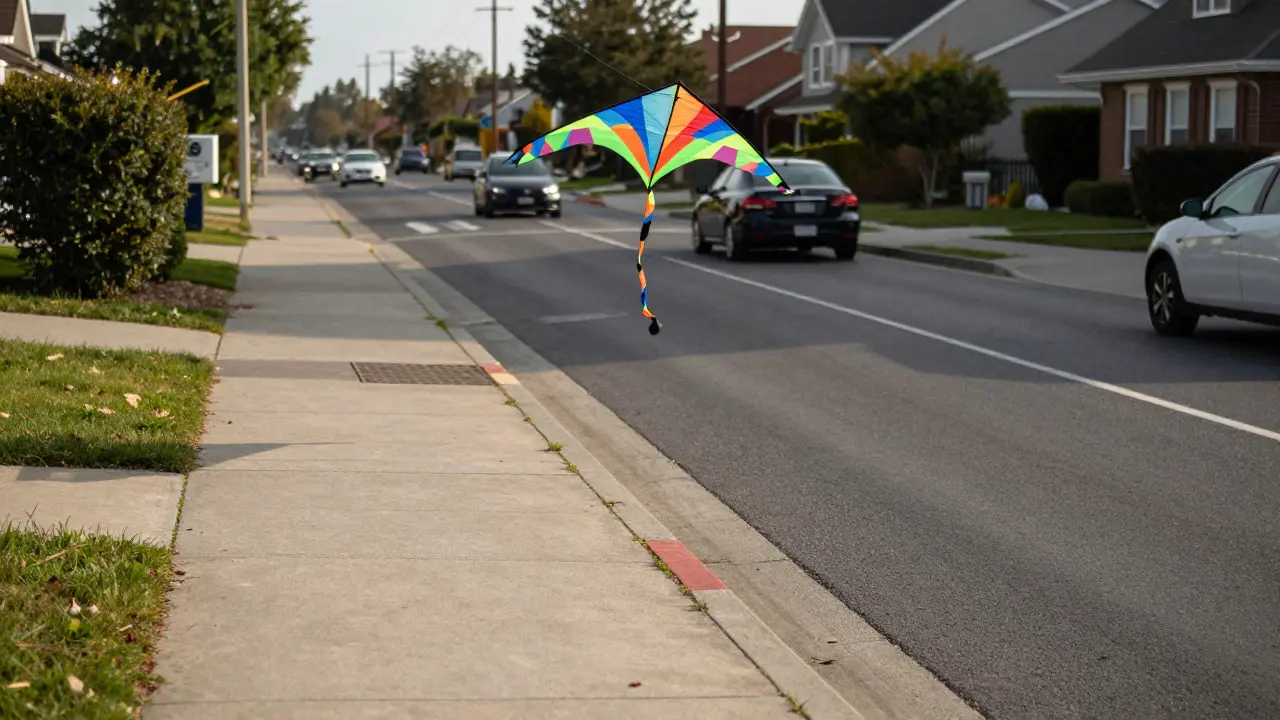
Flying near Roads is a dynamic hazard involving moving vehicles that requires maintaining a lateral buffer zone to prevent collisions and driver distraction. is tricky because cars move fast and drivers may not expect a kite overhead. The danger isn’t always the kite hitting a car; it’s the kite line whipping across a windshield or distracting a driver.
For residential streets with speed limits under 35 mph, aim for a minimum distance of 50 feet from the curb. For highways or arterials with speeds over 45 mph, increase that to 100 feet or more. But distance isn’t the only factor-wind direction matters. If the wind is blowing parallel to the road, your kite will travel long distances down the street. If the wind is blowing perpendicular to the road, your kite will swing toward or away from traffic.
Always position yourself so the wind pushes the kite away from the road. If you’re on the north side of an east-west road and the wind is blowing from the south, your kite will naturally drift north, away from traffic. If the wind is from the north, your kite will drift south, toward the cars. In that case, either wait for the wind to shift or find a new location. Never fly directly over a busy intersection, as visibility is poor and reaction times are short.
Comparing Hazards: Risk Levels and Required Distances
To help you quickly assess your flying site, here is a comparison of the three major hazards. Use this table as a quick reference before you start reeling in your line.
| Hazard Type | Primary Risk | Minimum Safe Distance | Key Consideration |
|---|---|---|---|
| Power Lines | Electrocution, Arc Flash | 100-150 ft (30-45 m) | Wind speed and humidity affect conductivity |
| Trees | Entanglement, Line Break | 2x Tree Height | Vertical clearance and branch spread |
| Roads | Vehicle Collision, Driver Distraction | 50-100 ft (15-30 m) | Wind direction relative to traffic flow |
Note that these distances are minimums. In ideal conditions, you should aim for even more space. If you’re unsure, pick a different spot. There’s no prize for flying closest to the danger.
Practical Tips for Assessing Your Location
Before you launch, take two minutes to scan your surroundings. Look up, not just forward. Check the sky for birds, planes, and other kites. Birds can tangle with your line, and planes (especially helicopters) create downdrafts that can knock your kite out of control. Other kites can lead to line crossings, which can snap both lines and send kites crashing down.
Use your phone’s compass app to note the wind direction. Stand with your back to the wind. Your kite will fly away from you. Ensure that path is clear of obstacles. If the wind shifts, your kite will shift with it. Be ready to adjust your position or let the kite land gently if the wind changes drastically.
Finally, tell someone where you’re flying. If you’re in a remote area, carry a whistle or a fully charged phone. Accidents can happen, and having a way to signal for help is a smart precaution. Wear comfortable shoes-you’ll be walking around to find the best spot and retrieving your kite if it lands in grass or mud.
Common Mistakes Beginners Make
Even after reading the rules, beginners often slip up. Here are the most common errors and how to avoid them:
- Ignoring Humidity: Wet air conducts electricity better. On humid days, increase your distance from power lines.
- Underestimating Wind Gusts: A steady breeze can suddenly turn into a gust. Keep a slack line ready to absorb the shock.
- Flying Near Fences: Chain-link and wooden fences can snag kite tails and lines. Stay at least 20 feet away from any fence.
- Not Checking for Overhead Wires: Sometimes, temporary wires are strung for construction events. Ask locals or check for signs.
- Assuming the Kite Will Stay Put: Kites drift. Constantly monitor their position relative to hazards.
Avoiding these mistakes takes practice. Start in open fields with few obstacles. As your skills improve, you can handle more complex environments. But always respect the basics.
FAQ
How far should I stay from power lines when flying a kite?
Aim for at least 100 feet (30 meters) away from distribution lines and 150 feet (45 meters) from high-voltage transmission lines. Increase this distance if the weather is humid or windy.
Is it safe to fly a kite near trees?
Yes, provided you maintain a horizontal distance of at least twice the height of the tallest tree. This ensures your kite clears the canopy and branches.
What is the best wind direction for flying near a road?
Fly with the wind pushing the kite away from the road. If the wind blows parallel to the road, be cautious as the kite may travel long distances along the street.
Can a kite line conduct electricity?
Yes, especially if the line is wet or has debris attached. Nylon monofilament is less conductive than braided lines, but all lines can pose a risk near high voltage.
How do I estimate my kite's height?
If your kite is at a 45-degree angle to the horizon, its height is approximately equal to the horizontal distance from you to the point directly below it. Use this to judge if it’s clearing nearby obstacles.