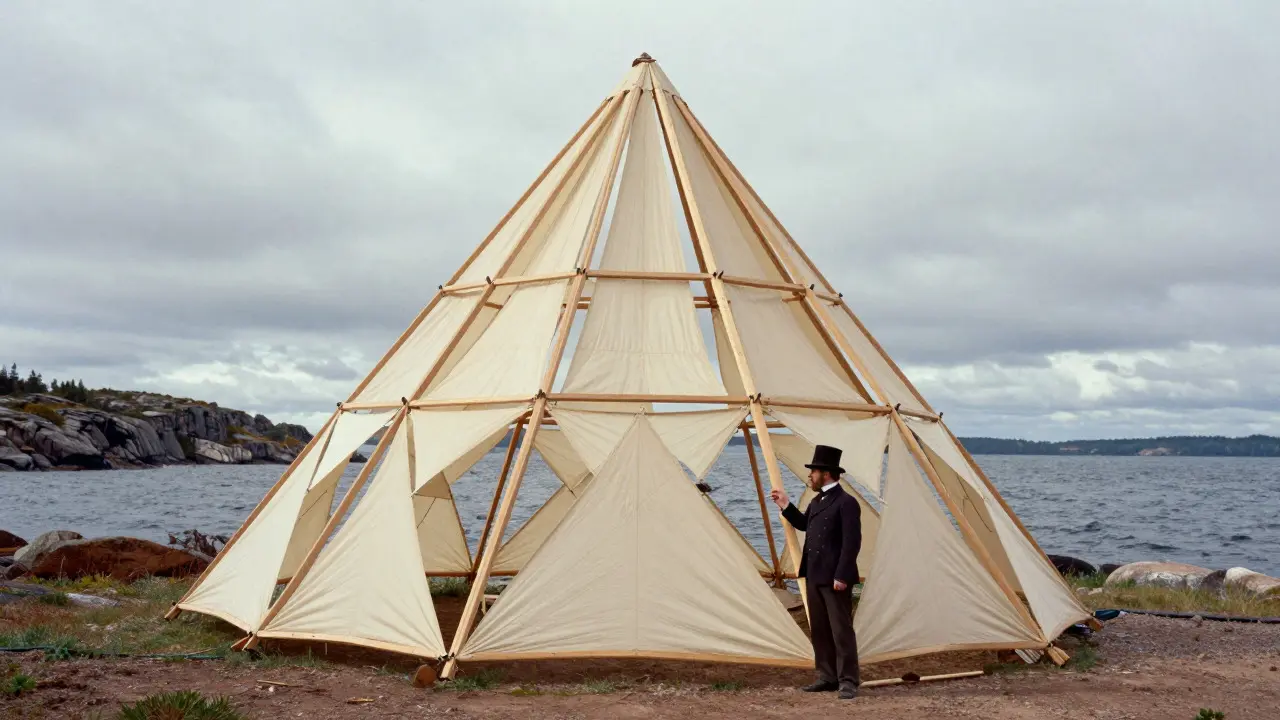
Most people know Alexander Graham Bell as the inventor of the telephone. But in the early 1900s, he was obsessed with something else entirely: making machines fly. His solution wasn't a rigid airplane wing. It was a giant, flexible structure made of hundreds of small triangles. This design, known as the Tetrahedral Kite, became one of the most important stepping stones toward powered aviation.
The story starts not in a lab, but on the shores of Bras d'Or Lake in Nova Scotia. In 1894, Bell built his first experimental tetrahedral cell. He noticed that when these triangular frames were connected, they created a surface that was incredibly strong yet light. More importantly, it stayed stable in wind without needing complex control surfaces. This observation sparked a decade of intense research that would eventually lead to the first successful manned flights in North America.
Why Triangles? The Physics Behind the Design
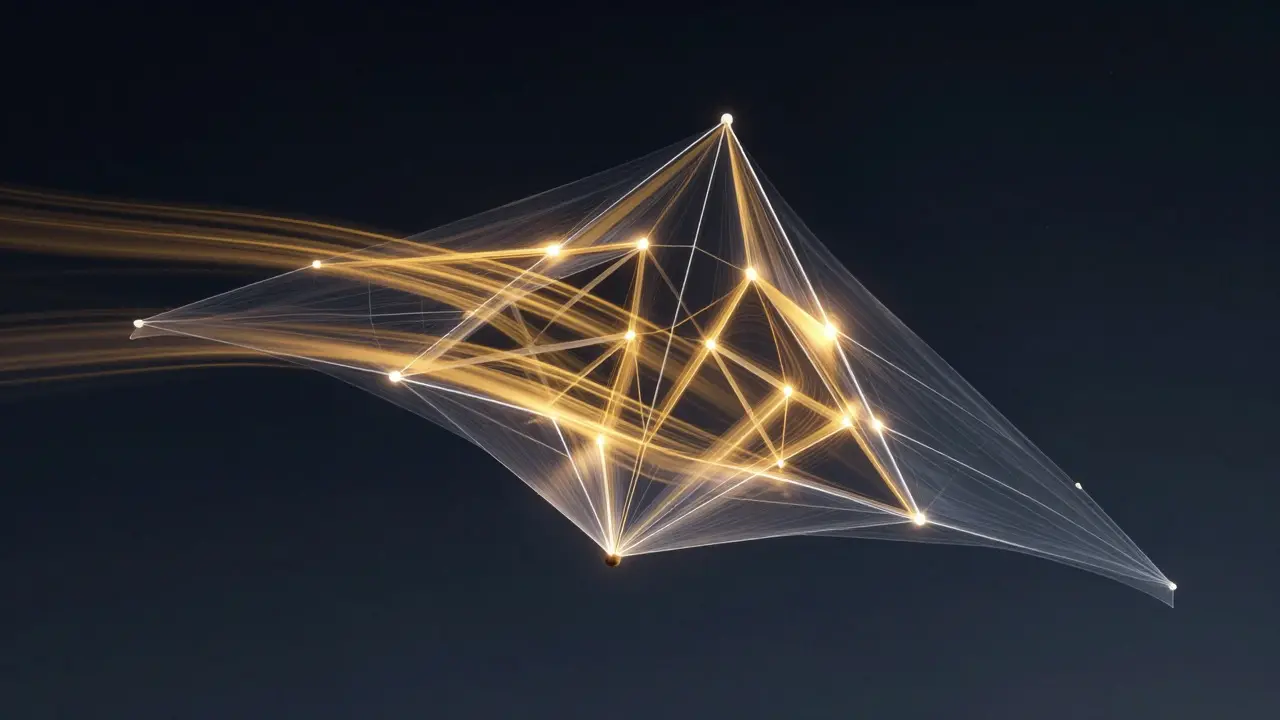
To understand why Bell chose this shape, you have to look at basic geometry and aerodynamics. A triangle is the only polygon that cannot be deformed without changing the length of its sides. This rigidity meant that each individual cell of the kite could withstand high air pressure without collapsing. When you connect multiple tetrahedrons (pyramids with four triangular faces), you create a lattice structure that distributes stress evenly across the entire frame.
Bell realized that by increasing the number of cells, he could increase the lift while keeping the weight manageable. A single large wing might bend or break under load, but a grid of small triangles acts like a suspension bridge. Each strut bears a portion of the weight, and the fabric covering the structure provides the necessary surface area to catch the wind. This modular approach allowed him to scale up from a small hand-held model to a kite spanning over 50 feet wide.
| Feature | Traditional Rigid Wing | Tetrahedral Kite Structure |
|---|---|---|
| Structural Integrity | Depends on internal spars and ribs; prone to bending | Distributed load via triangulation; highly rigid |
| Weight-to-Strength Ratio | Moderate; requires heavy materials for stiffness | High; lightweight struts support significant loads |
| Flexibility | Low; risk of structural failure in gusts | High; cells flex individually, absorbing shock |
| Assembly Complexity | Complex joinery required | Modular; simple joints between identical parts |
The Aerial Experiment Association
Bell didn't work alone. In 1907, he founded the Aerial Experiment Association (AEA) in Baddeck, Nova Scotia. The group included key figures like Casey Baldwin, J.A.D. McCurdy, Frederick Walker, and Thomas Selfridge. Their goal was ambitious: to build a heavier-than-air machine that could carry a human being.
They started by building larger and larger unpowered kites to test the structural limits of the tetrahedral design. The biggest challenge was controlling the craft. Unlike a bird, which can adjust its feathers, a rigid structure needs external mechanisms to steer. Bell and his team experimented with various control surfaces, including elevators and rudders attached to the trailing edge of the kite. They learned quickly that stability came naturally from the shape, but maneuverability had to be engineered.
From Kites to Powered Flight
By 1908, the team had perfected their "Red Wing" glider, a massive tetrahedral kite that could stay aloft in steady winds. The next step was adding an engine. They installed a 30-horsepower Curtiss Engine into a modified version of the Red Wing. This created the first Canadian aeroplane, often referred to as the Silver Dart's predecessor in terms of design lineage, though the Silver Dart itself used a different wing configuration later on.
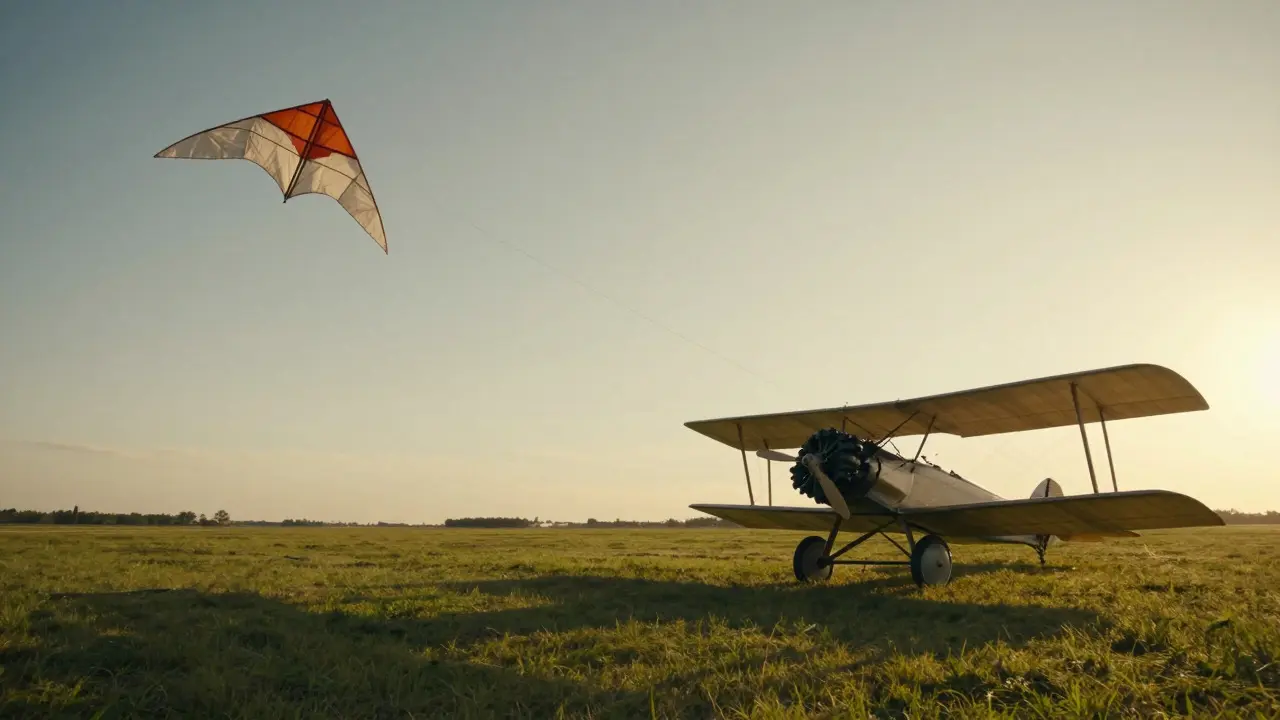
The breakthrough moment came on February 23, 1909. Casey Baldwin flew the AEA's first powered machine, a triplane design that incorporated lessons from the tetrahedral kites. However, the true validation of the tetrahedral concept came with the Silver Dart. While the Silver Dart used a conventional biplane layout, its development was directly informed by the AEA's years of testing tetrahedral structures. The data collected on lift, drag, and control during the kite phase proved essential for designing a safe, controllable aircraft.
It’s worth noting that the tetrahedral design didn't immediately replace traditional wings. In fact, it fell out of favor because manufacturing thousands of identical triangular cells was labor-intensive compared to building a few large wooden ribs. But the principles Bell discovered-specifically regarding distributed loading and aerodynamic stability-became fundamental to aerospace engineering.
Legacy and Modern Applications
You might think the tetrahedral kite is just a historical curiosity. But its influence is still visible today. The concept of using triangulated structures for strength and lightness is everywhere. Look at the space shuttle's payload bay doors, or the trusses on modern skyscrapers. Even in consumer products, you see similar logic in the design of folding chairs and camera tripods.
In the world of drones and unmanned aerial vehicles (UAVs), there has been renewed interest in flexible, multi-cell designs. These structures can survive impacts that would shatter a rigid carbon fiber wing. Researchers are looking back at Bell's work to find ways to make autonomous flying objects more resilient. The idea that flexibility leads to durability is a counter-intuitive lesson that Bell mastered over a century ago.
Key Takeaways
- Structural Efficiency: The tetrahedral design uses triangulation to distribute weight and stress, allowing for lighter and stronger structures than traditional beams.
- Historical Significance: Alexander Graham Bell's experiments with tetrahedral kites provided crucial aerodynamic data that helped pioneer powered flight in North America.
- Control Challenges: While the shape offered natural stability, steering required innovative control surfaces, a problem the AEA solved through iterative testing.
- Modern Relevance: Principles of modular, flexible structures derived from Bell's work are now applied in drone technology and architectural engineering.
Frequently Asked Questions
What is a tetrahedral kite?
A tetrahedral kite is a type of kite constructed from a series of interconnected triangular cells. Each cell is a tetrahedron, a pyramid with four triangular faces. The structure is covered in fabric, creating a large, flexible lifting surface that is both strong and lightweight.
Did Alexander Graham Bell invent the airplane?
Not exactly. Bell is best known for the telephone, but he played a pivotal role in early aviation. Through the Aerial Experiment Association, he funded and directed research that led to some of the first successful powered flights in Canada. His tetrahedral kite designs laid the groundwork for understanding how to build stable, heavier-than-air machines.
Why did the tetrahedral kite design fall out of popularity?
The primary reason was manufacturing complexity. Building a large tetrahedral structure requires assembling hundreds of individual struts and joints, which is time-consuming and expensive compared to building a few large wooden or metal ribs. As aircraft engines became more powerful, the need for extreme lightness decreased, making simpler, rigid wing designs more practical for mass production.
How does a tetrahedral structure compare to a standard airplane wing?
A standard wing relies on internal spars and ribs to maintain its shape. A tetrahedral structure relies on the geometric stability of triangles. The tetrahedral design is generally more resistant to deformation under uneven loads but creates more drag due to its porous, lattice-like nature. Standard wings offer smoother airflow and lower drag, which is critical for speed and fuel efficiency.
Are tetrahedral designs used in modern technology?
Yes, while not common in commercial passenger jets, the principles are used in various fields. Spacecraft use truss structures similar to tetrahedral lattices for their strength-to-weight ratio. In robotics and drone design, flexible, multi-cell frameworks are being explored to create vehicles that can absorb impact better than rigid structures.