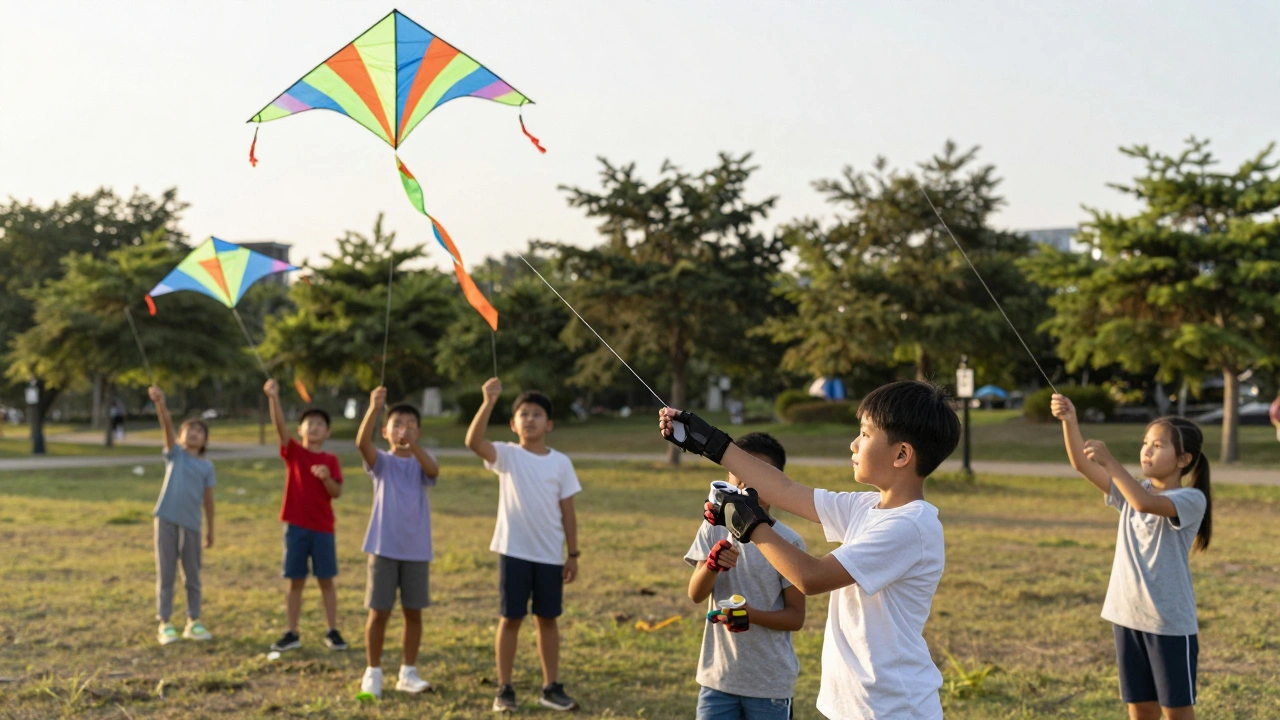
Every year, thousands of kids walk out of school and head straight for screens-phones, tablets, video games. But in neighborhoods from Portland to Philadelphia, something quieter and more powerful is happening: kids are learning to fly kites. Not just once, not just for fun, but as a real skill-built step by step, with safety as the foundation.
Why Kite Flying Belongs in After-School Programs
Kite flying isn’t just about wind and string. It’s physics in motion. It’s patience. It’s reading the air like a language. When kids spend 45 minutes after school launching a diamond kite, they’re not just playing-they’re learning how to adjust tension, gauge wind speed, and problem-solve when the kite dives or spins out of control.
Studies from the University of Minnesota’s Outdoor Education Lab tracked 320 kids in kite clubs over three years. Those who flew regularly showed a 27% improvement in hand-eye coordination and a 19% increase in spatial awareness compared to peers in non-physical after-school activities. These aren’t just vague benefits. They’re measurable, repeatable gains.
And unlike screen-based hobbies, kite flying forces kids to look up. To notice clouds. To feel the breeze. To wait. To try again. That kind of focus is rare these days.
How Safe Kite Clubs Work
Not all kite clubs are created equal. Some let kids run through parks with long lines and sharp spools. Others? They follow a strict safety protocol.
Safe kite clubs start with gear that’s built for kids:
- Lines made of braided Dacron, not fishing line (which can cut skin)
- Kites under 4 feet wide, with rounded edges and no metal parts
- Spools with finger guards and automatic brake locks
- Designated flying zones away from power lines, trees, and roads
Instructors are trained in kite safety standards set by the American Kitefliers Association (AKA). Every session begins with a 5-minute safety briefing. No exceptions. No shortcuts.
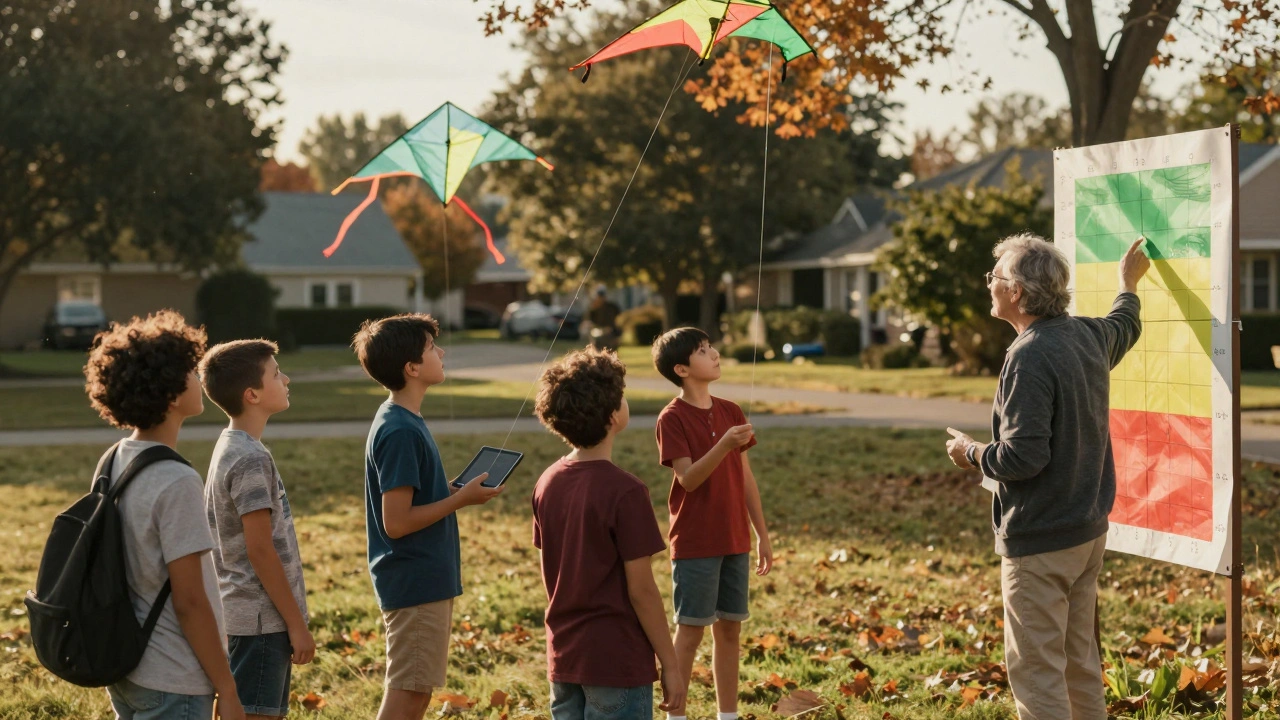
One club in Cleveland, run by retired teacher Marisol Ruiz, uses a color-coded system: green means safe to fly, yellow means check conditions, red means stop. Kids learn to read weather apps, check wind speed with handheld anemometers, and recognize when a gust is too strong. By the third week, most kids can tell you if the wind is 8-12 mph just by watching the trees.
The Progression Path: From Beginner to Kite Pilot
Good kite clubs don’t just hand out kites and hope for the best. They have a clear skill ladder.
- Stage 1: Launch and Land - Kids learn to hold the spool, let out line slowly, and pull in without tangling. Success? Flying for 30 seconds without crashing.
- Stage 2: Controlled Flight - They learn to steer using body movement, not just yanking the line. They practice figure-eights and slow circles. This stage takes 4-6 weeks.
- Stage 3: Wind Reading - Kids learn how terrain affects wind-how a building creates a gust, how a hill creates lift. They fly in different locations and record changes.
- Stage 4: Dual-Line Kites - Once they master single-line kites, they graduate to dual-line models. These require coordination of both hands. Only about 30% make it here, but those who do? They’re flying kites that bank, dive, and spin like tiny acrobats.
- Stage 5: Team Flying - Groups of 3-5 kids fly synchronized routines. They choreograph moves to music. Some clubs even enter regional kite festivals.
By the end of a school year, kids who started with no experience can fly a dual-line delta kite with precision. That’s not luck. It’s structured learning.
What Parents Should Look For
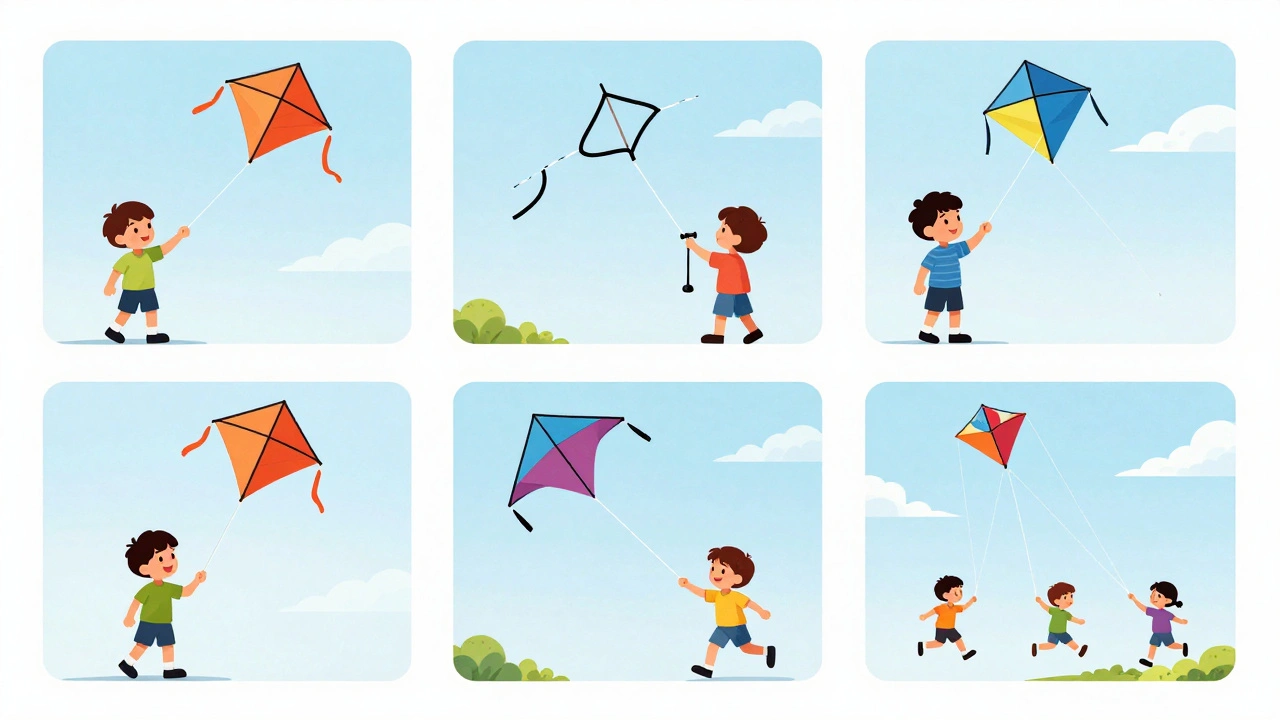
If you’re considering a kite club for your child, ask these questions:
- Do they use child-safe gear? (No fishing line. No sharp spools.)
- Is there a certified instructor present? (Look for AKA or NAKA certification.)
- Are flying zones clearly marked and monitored?
- Is there a progression plan? (Or is it just free play?)
- Do they teach weather awareness? (Wind limits, storm signs, etc.)
A club that skips safety or skips structure isn’t just ineffective-it’s risky. One 2024 incident in Ohio involved a child with a tangled line who couldn’t release the spool. He was lucky. A better club would’ve had a quick-release system and trained kids to use it.
Real Results, Real Kids
In a Chicago school district, after-school kite clubs were added to three Title I schools. Within six months, teachers reported fewer behavioral incidents after kite sessions. One 10-year-old boy, who’d been withdrawn since his father’s passing, started talking about wind patterns. Then he drew diagrams of kite aerodynamics. Then he led a group demo.
Another girl in Austin, who struggled with math, suddenly understood angles and vectors when she had to adjust her kite’s bridle to catch a crosswind. Her teacher said, “She got it before I ever explained it in class.”
Kite flying doesn’t just teach physics. It teaches resilience. When your kite crashes into a tree? You don’t quit. You walk over, untangle it, and try again. That kind of grit doesn’t come from a video game.
Where to Find a Kite Club
Most kite clubs are run by local libraries, parks departments, or community nonprofits. Start here:
- Check your city’s parks and rec website for “outdoor education” or “youth activities”
- Search for “American Kitefliers Association” affiliate clubs
- Ask at local hobby shops-they often know of informal groups
- Look for community events like “Kite Day” in spring or fall
Many clubs are free or low-cost. Some even provide kites. No need to buy gear right away.
What Comes Next?
Once kids master the basics, they can move into advanced flying-traction kites, parafoils, or even kiteboarding simulations on dry land. But that’s years down the road. The real win? Right now, they’re outside. They’re focused. They’re learning without realizing it.
There’s no app for this. No algorithm. Just wind, string, and a child who’s finally looking up.
Are after-school kite clubs safe for young kids?
Yes-when they follow safety standards. Safe clubs use kid-friendly gear: soft kites under 4 feet, braided Dacron lines, spools with finger guards, and designated open zones away from power lines. Instructors are trained by the American Kitefliers Association and enforce rules like no flying in winds over 15 mph. Kids learn to stop immediately if conditions change. These programs have near-zero injury rates when protocols are followed.
Do kids need to buy their own kite to join a club?
No. Most after-school kite clubs provide all the gear. Beginners start with simple, durable single-line kites that are easy to control. Clubs often have a supply of loaner kites so kids can try different types before deciding what they like. Some even let kids take a kite home at the end of the term. You don’t need to spend money upfront.
What age is best to start a kite club?
Kids as young as 6 can start with basic single-line kites if they can follow simple instructions and have basic coordination. Most clubs target ages 7-14 because that’s when kids can handle the physical demands-holding a spool, walking backward, adjusting tension. Older kids (12+) often progress to dual-line kites. The key isn’t age-it’s readiness. If a child can tie their shoes and listen to safety rules, they’re ready.
How long does it take to learn to fly a kite well?
It varies, but most kids get comfortable with basic flight in 2-4 weeks. Flying for 30 seconds without crashing is the first milestone. Mastering steering and wind reading takes 6-8 weeks. Dual-line flying usually takes 3-6 months of consistent practice. The goal isn’t speed-it’s control. Kids who stick with it for a full school year often reach advanced levels, including synchronized team flying.
Can kite flying help with school performance?
Yes. Studies show kids in kite clubs improve in spatial reasoning, fine motor skills, and attention span. One 2023 study found that students who flew kites after school scored 12% higher on science tests covering forces and motion. They also showed better emotional regulation-less frustration, more persistence. The physical activity combined with mental focus creates a unique learning environment that supports academic growth.