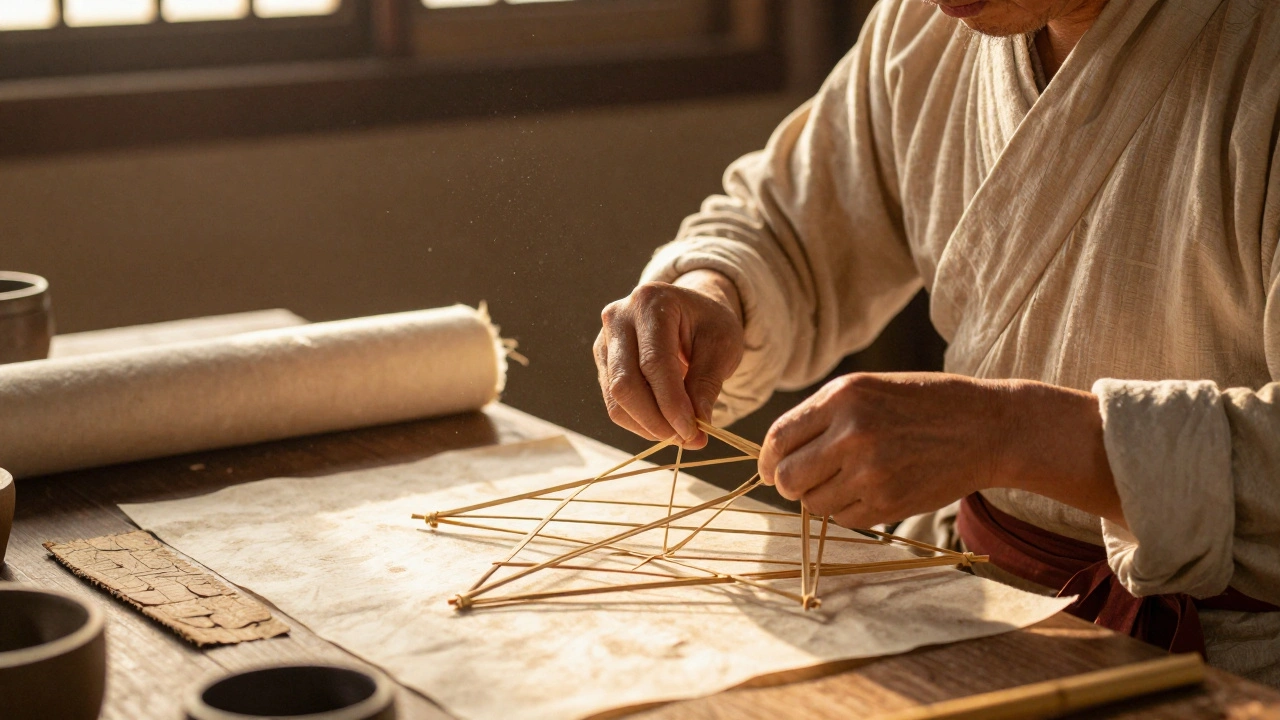
Picture a child in ancient China watching a square piece of silk dance against the wind, tethered by a thin string. Now picture a professional stunt pilot in California launching a delta-shaped machine made of ripstop nylon and carbon fiber that defies gravity with surgical precision. The object is the same-a kite-but the engineering behind it has undergone a radical transformation. What started as a simple toy or religious offering has evolved into a sophisticated aerodynamic device that pushes the boundaries of material science.
This isn't just about making kites prettier. It’s about how we learned to harness the wind more efficiently, safely, and controllably. Understanding this evolution reveals why your backyard flyer behaves so differently from the high-performance rigs used in sports today. Let’s look at how kite design moved from traditional craftsmanship to modern engineering.
The Ancient Foundation: Wood, Silk, and Geometry
To understand where we are going, we have to look at where we started. For thousands of years, kite design was limited by two things: what nature provided and what local artisans could craft. In China, around 500 BC, early kites were constructed using bamboo for the frame and mulberry bark paper or silk for the sail. Bamboo was the perfect choice-it’s lightweight, incredibly strong for its weight, and flexible enough to absorb gusts without snapping.
These early designs weren’t random. They followed strict geometric rules. The classic diamond shape, which most people still associate with kites today, emerged because it offered a stable center of pressure. If you’ve ever flown a basic diamond kite, you know it wants to fly straight up if the bridle is tied correctly. That stability came from centuries of trial and error. Artisans also added tails not just for decoration, but to add drag and stabilize the kite in turbulent air. Without that tail, the kite would spin out of control.
In other parts of the world, materials varied based on availability. In Japan, Edo period kites often featured intricate paintings and loud whistles attached to the frame, turning them into auditory signals as well as visual ones. In South America, indigenous groups used feathers and plant fibers. The common thread was always natural materials. These materials had limitations-they absorbed moisture, rotted over time, and couldn’t be mass-produced with consistent dimensions. But they worked well enough for leisure and even military signaling.
The Scientific Turn: Aerodynamics and Experimentation
For a long time, kite flying was purely recreational or ceremonial. That changed in the 18th and 19th centuries when scientists realized kites could help them study the atmosphere. This shift forced designers to think less about aesthetics and more about performance. Benjamin Franklin famously flew a kite during a thunderstorm in 1752 to prove that lightning was electrical. While the story goes that he got shocked (he didn’t, thanks to a wet hemp string), his experiment highlighted the potential of kites as scientific tools.
Later, Ludwig Prandtl and other pioneers of aerodynamics began testing different wing shapes. They discovered that lift wasn’t just about surface area; it was about how air flowed over and under the structure. This led to the development of box kites in the late 19th century. Designed by Lawrence Hargrave in Australia, the box kite was revolutionary. It generated significant lift relative to its size and could be linked together to carry instruments-or eventually, people-into the sky.
This era marked the transition from "toy" to "tool." Designers started paying attention to the angle of attack, the aspect ratio of the wings, and the structural integrity needed to withstand higher altitudes. The materials remained largely wood and canvas, but the construction became more precise. Joints were reinforced, and sails were tensioned tighter to maintain their shape against the wind. This precision laid the groundwork for the aviation boom that would follow.
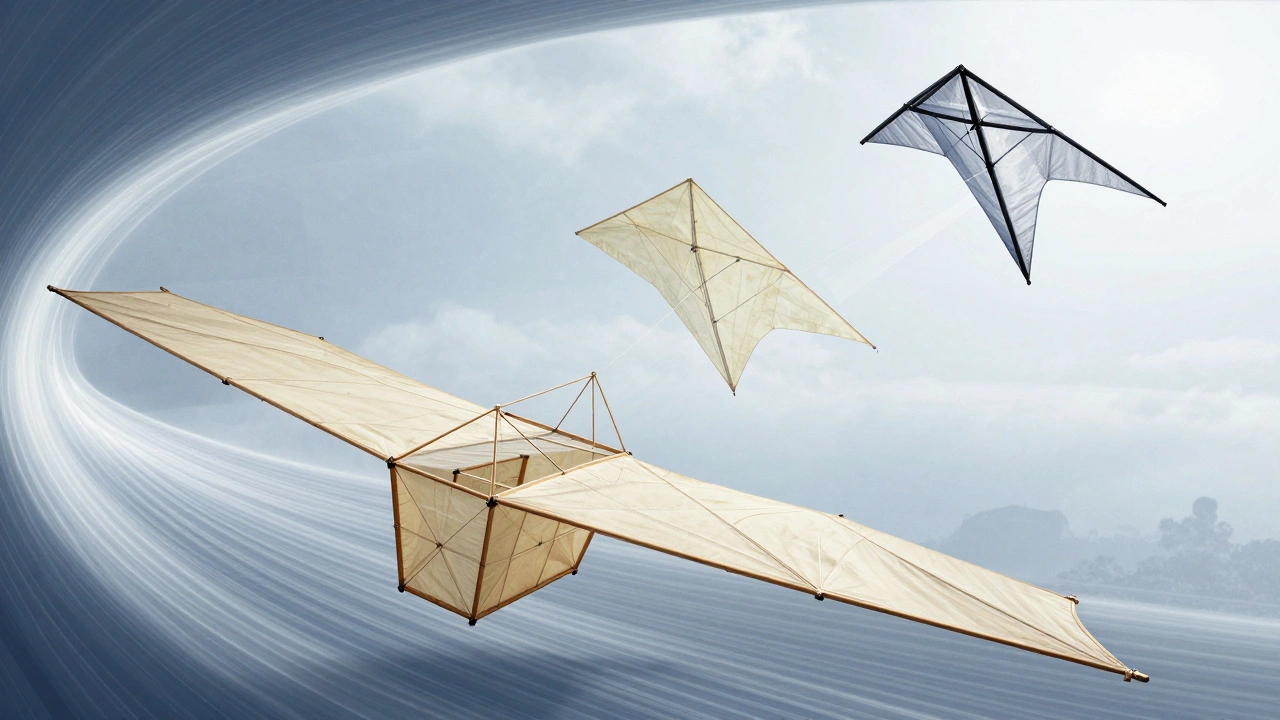
The Age of Synthetics: Nylon and Plastic Revolutionize Flight
If the 19th century was about understanding aerodynamics, the mid-20th century was about material innovation. World War II accelerated the development of synthetic polymers, and after the war, these materials trickled down to consumer goods. The biggest game-changer for kite design was Nylon.
Before nylon, kite sails were heavy cotton or silk. Nylon was lighter, stronger, and water-resistant. It didn’t stretch much when wet, which meant the kite kept its aerodynamic shape even in humid conditions. This allowed for larger kites that could fly in lighter winds. Suddenly, you didn’t need a gale to get airborne. You could fly on a breezy afternoon with a kite that weighed only a few ounces.
Frames also evolved. While bamboo was still popular among traditionalists, Fiberglass rods began to appear. Fiberglass was uniform in thickness and strength, unlike bamboo, which had nodes and varying densities. This consistency made manufacturing easier and repairs simpler. If a fiberglass rod broke, you could splice it with epoxy and keep flying. With bamboo, a break often meant starting over.
Plastic connectors replaced wooden dowels and twine lashing. Injection-molded plastic joints allowed for quick assembly and disassembly. This convenience turned kite flying into a mainstream hobby rather than a specialized craft. Families could buy a kit, snap it together in minutes, and launch it. The barrier to entry dropped significantly, leading to an explosion in kite popularity during the 1970s and 80s.
Modern Composites: Carbon Fiber and Ripstop Nylon
Today, high-performance kites are built using materials that sound like they belong in aerospace engineering. The dominant frame material is now Carbon Fiber. Carbon fiber offers an incredible strength-to-weight ratio. It’s stiffer than fiberglass and lighter than aluminum. This stiffness is crucial for stunt kites, which rely on precise control surfaces to perform loops, rolls, and sharp turns. A flexible frame would flex under load, causing lag in response and making maneuvers impossible.
The sails have also upgraded from standard nylon to Ripstop Nylon. Ripstop fabric features a reinforced grid pattern that prevents tears from spreading. If you puncture a regular nylon sail, the hole can grow rapidly under stress. With ripstop, the tear stops at the next reinforcement line. This durability is essential for competitive pilots who push their kites to the limit.
Additionally, modern kites often use Dacron or polyester blends for specific sections that require low stretch. Stretch in the sail can distort the aerodynamic profile, reducing efficiency. By minimizing stretch, designers ensure that the kite maintains its intended shape across a wide range of wind speeds. This level of material selection allows for kites that can fly in winds as light as 3 mph or as strong as 30 mph, depending on the model.
| Material Era | Frame Material | Sail Material | Key Advantage | Limitation |
|---|---|---|---|---|
| Ancient (Pre-1900) | Bamboo / Wood | Silk / Paper | Natural flexibility | Heavy, rot-prone |
| Early Modern (1900-1950) | Wood / Canvas | Cotton / Canvas | Durable structure | High weight, poor weather resistance |
| Synthetic Age (1950-1990) | Fiberglass | Nylon | Lightweight, consistent | Flexible, prone to stretching |
| Composite Era (1990-Present) | Carbon Fiber | Ripstop Nylon / Dacron | High stiffness, tear-resistant | Higher cost, brittle impact |
Design Complexity: From Single-Line to Dual-Line Control
Materials alone don’t explain the evolution of kite design. The way we control kites has also become vastly more complex. Early kites were single-line flyers. You held one string, and the kite did what it wanted within the constraints of its geometry. Stability was passive. If the wind shifted, the kite adjusted automatically.
The introduction of dual-line control in the 1970s changed everything. By adding a second line attached to opposite corners of the kite, pilots could steer actively. Pulling one line tighter than the other caused the kite to bank and turn. This opened up the possibility of acrobatics. Stunt kites, typically delta-shaped, became popular because their wide wingspan provided ample lift for tight turns.
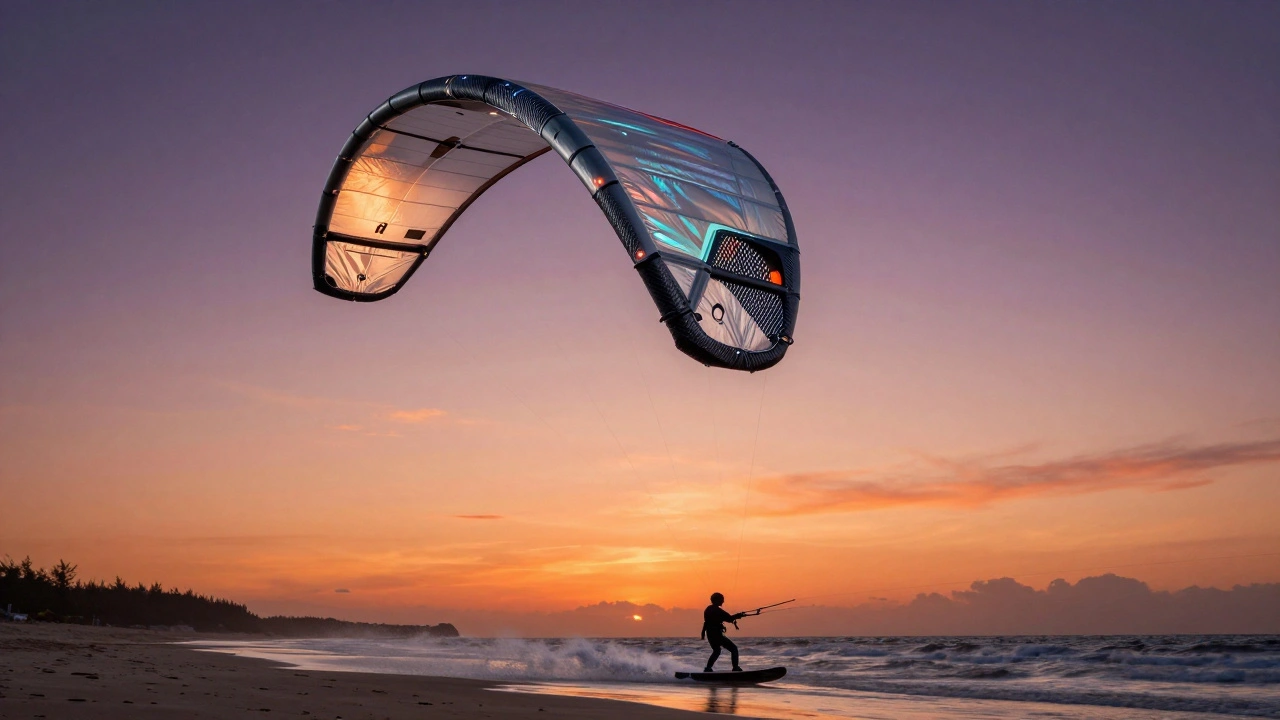
Today, we see quad-line kites used in power kiting and landboarding. These systems allow for reverse flight, meaning the kite can generate pull even when moving backward. This capability enables riders to tow themselves across snow, sand, or grass. The design of these kites incorporates C-shapes or bow shapes that create deep pockets of lift. The bridle points are adjustable, allowing pilots to fine-tune the window position and responsiveness. This level of control requires precise engineering of both the frame and the sail tension.
Future Trends: Smart Materials and Automation
Where do we go from here? The next frontier in kite design involves smart materials and automation. Researchers are experimenting with Shape Memory Alloys that can change the curvature of the wing in real-time. Imagine a kite that adjusts its camber automatically to optimize lift as wind speed changes. This would eliminate the need for manual trim adjustments.
Another trend is the integration of sensors. Some modern kites include GPS trackers and wind speed sensors embedded in the frame. This data helps pilots avoid dangerous conditions and optimize their flight paths. For commercial applications, such as kite-powered electricity generation, automated control systems are already being tested. These systems use algorithms to steer the kite in figure-eight patterns to maximize energy extraction from the wind.
As materials continue to improve, we may see kites that are self-healing or capable of repairing minor damage through heat activation. The dream is a kite that is not only highly performant but also maintenance-free. Until then, the core principles remain the same: balance weight, strength, and aerodynamics to dance with the wind.
Why is carbon fiber better than bamboo for modern kites?
Carbon fiber offers a superior strength-to-weight ratio compared to bamboo. It is significantly stiffer, which allows for precise control in stunt kites, and it does not absorb moisture, preventing degradation over time. Bamboo, while flexible and traditional, varies in density and can rot or split if not properly maintained.
What is the purpose of ripstop nylon in kite sails?
Ripstop nylon features a reinforced grid pattern that stops tears from propagating. If the sail gets punctured, the tear will stop at the next reinforcement line, preventing the entire sail from ripping apart. This makes the kite much more durable and repairable compared to standard nylon.
How did the invention of the box kite influence aviation?
The box kite, invented by Lawrence Hargrave, demonstrated that rigid structures could generate significant lift. This concept influenced early aircraft design, particularly in the development of biplanes and triplanes. It showed that lift could be achieved without relying solely on flexible membranes, paving the way for heavier-than-air flight.
Can I fly a modern carbon fiber kite in light winds?
Yes, many modern kites are designed specifically for low-wind conditions. Because carbon fiber is so light, the overall weight of the kite is reduced, requiring less wind to generate lift. Look for models labeled as "low wind" or with large surface areas relative to their weight.
What is the difference between single-line and dual-line kites?
Single-line kites are passive and stable, flying primarily based on their shape and tail. They are easy to fly but offer little control. Dual-line kites have two lines attached to opposite corners, allowing the pilot to steer actively by pulling one line tighter than the other. This enables tricks, turns, and dynamic flight patterns.